
Meeting on the sidelines of the Aswan Forum, the three foreign ministers said Red Sea security belongs to the states on its shores and rejected “unilateral measures” on water, a line Addis Ababa has already said ignores Ethiopia’s interests.
By HahuPrime News Desk | November 22, 2026
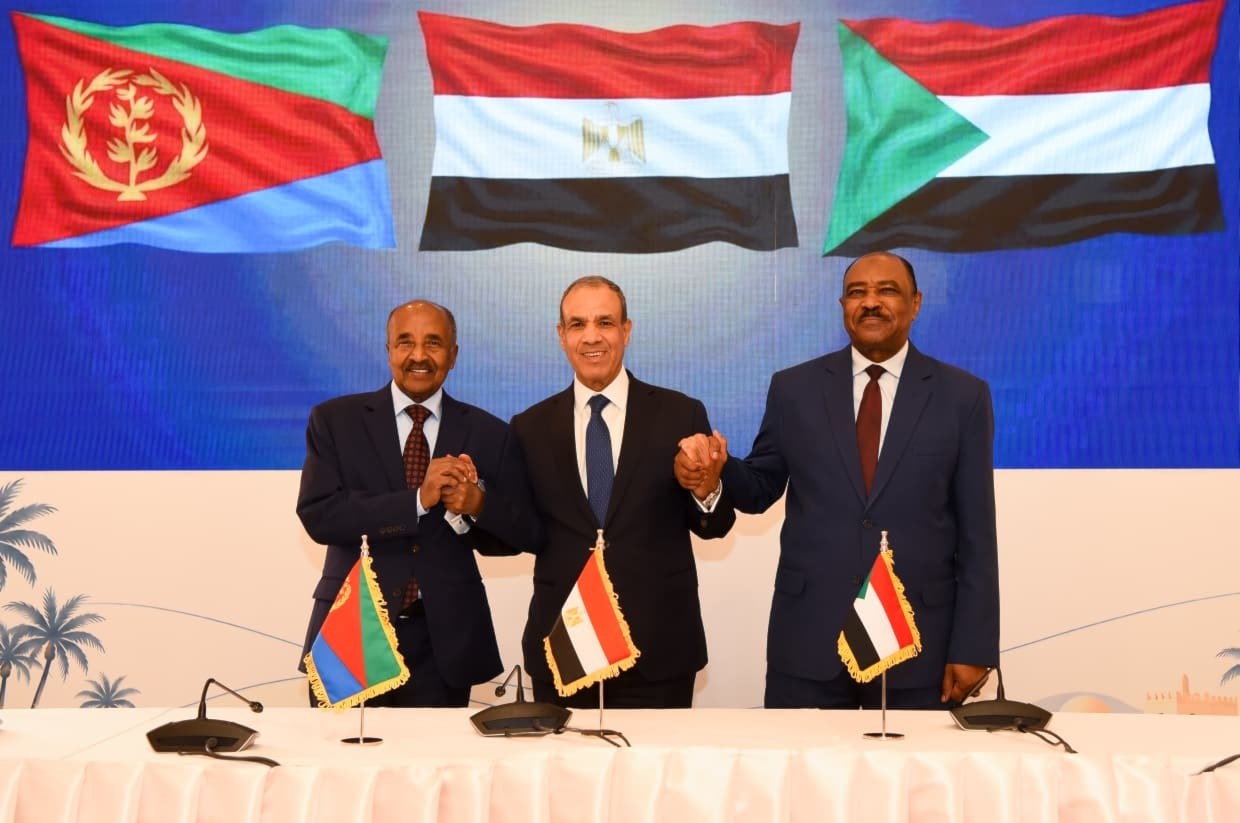
ASWAN, Egypt — Under a backdrop of the Eritrean, Egyptian and Sudanese flags, three foreign ministers stood shoulder to shoulder in Aswan on Saturday and joined hands for the cameras. Egypt’s Badr Abdelatty stood in the middle, with Eritrea’s Osman Saleh on one side and Sudan’s Mohieldin Salem on the other.
The statement that followed was brief. Its message for the Horn of Africa was not.
Meeting on the sidelines of the sixth Aswan Forum for Sustainable Peace and Development, the three ministers said the responsibility for governing the Red Sea and protecting its security “lies with the littoral states”, according to a readout issued by Egypt’s Ministry of Foreign Affairs. They also rejected “unilateral measures, whether in the security field or on water security issues”.
The statement named no country. But both phrases echo positions that Ethiopia, the region’s most populous state, has publicly rejected. Ethiopia has no coastline, wants access to the sea, and is the source of most of the water flowing through the Blue Nile, where its Grand Ethiopian Renaissance Dam (GERD) has been disputed by Cairo and Khartoum for more than a decade.
What the three ministers agreed
Ambassador Nader Zaki, the Egyptian foreign ministry’s spokesman, said the ministers agreed to build on the “momentum” in their relations and to step up consultation and coordination on issues of shared interest. They stressed freedom of navigation and the safety of international shipping lanes.
On Sudan, where the army has been fighting the paramilitary Rapid Support Forces (RSF) since April 2023, they called for respect for the country’s sovereignty and unity and for the preservation of its national institutions. They rejected “the role of armed militias and their arming from abroad”.
They renewed support for Somalia’s territorial integrity and rejected “the establishment of any parallel entities”, wording widely read as a reference to Somaliland, which declared independence in 1991 and is not recognised by most governments. The ministers also affirmed support for the unity and territorial integrity of Eritrea.
The ministry said the talks aimed above all to uphold the principle of non-interference in the internal affairs of states. Somalia was not in the room, but Abdelatty said he would brief Mogadishu on what was discussed, to keep up the four-way consultation launched by the leaders of the four countries in New Alamein in October.
Neither Sudan’s nor Eritrea’s foreign ministry had published its own account of the meeting by Saturday evening, according to Daily News Egypt. The quotations above come from the Egyptian readout.
Abdelatty warns of a crowded waterway
Earlier on Saturday, the same three ministers sat on a forum round table on security in the Red Sea and the Horn of Africa. UN and African Union envoys, the EU’s Horn of Africa representative and International Crisis Group president Comfort Ero also took part.
According to the Egyptian foreign ministry, Abdelatty warned that the militarisation of the Red Sea, the growing foreign military presence and the “multiplicity of parallel naval operations” were deepening tension and threatening international shipping and trade. He also cautioned against the policies of “some regional parties” that, he said, threaten the stability and sovereignty of Horn of Africa states. He did not name them.
The argument is not new for Cairo. Egypt depends heavily on Suez Canal revenue, which fell sharply after attacks on shipping in the southern Red Sea, and President Abdel Fattah al-Sisi made a similar case against “militarisation” by non-coastal states at a summit in Moscow last month.
Why Addis Ababa is listening
The Aswan wording follows almost word for word the El Alamein Joint Declaration, signed in early October by Sisi, Eritrea’s President Isaias Afwerki, Somalia’s President Hassan Sheikh Mohamud and Sudan’s army chief Abdel Fattah al-Burhan. That declaration called Red Sea governance “the exclusive responsibility of the littoral states” and rejected unilateral steps that harm the water uses of Egypt and Sudan, as HahuPrime reported at the time.
Ethiopia answered the next day. Its foreign ministry said that “any serious discussion of regional maritime affairs and security architecture must account for Ethiopia’s legitimate interests and its enduring connection to the Red Sea”, noting that its nearest border lies barely 30 miles from the coast. It said the Abay, as the Blue Nile is known in Ethiopia, supplies about 85 percent of the Nile’s total flow.
“These geographic and historical realities cannot be altered by political rhetoric, coercive measures, or acts of destabilisation,” the ministry said at the time. HahuPrime found no Ethiopian government comment on the Aswan meeting by Sunday morning.
The timing adds weight. Ethiopia and Eritrea have massed troops along their shared border, with Badme again a flashpoint, and the G7 has warned that the standoff risks wider regional escalation. Addis Ababa and Khartoum have traded accusations of backing each other’s armed opponents, while fighting in Sudan’s Blue Nile state has moved closer to the Ethiopian border. Ethiopia, for its part, hosted a Red Sea naval forum last month that included Somaliland and Puntland but not the federal government in Mogadishu.
Seen from Addis Ababa, Saturday’s meeting was a further sign that Egypt, Eritrea and Sudan are acting as a bloc on the two questions Ethiopia cares about most: the sea and the Nile. For Asmara, aligning with Cairo brings diplomatic cover at a time of open hostility with Ethiopia. For Sudan’s army-led government, it adds support for its fight against the RSF.
What comes next
The Aswan Forum closes on Sunday. Egypt is expected to brief Somalia on the talks, and the four governments say they will keep coordinating through the mechanism set up at New Alamein.
Whether Addis Ababa responds formally, as it did in October, will show how seriously it reads the latest statement. So far the bloc has kept its language general, naming no target, while leaving little doubt about who it has in mind.
Sources
- Egyptian Ministry of Foreign Affairs readout of the trilateral meeting, via the State Information Service (Arabic), November 21, 2026
- Egyptian Ministry of Foreign Affairs statement on the Red Sea and Horn of Africa round table, via the State Information Service and Maspero, November 21, 2026
- Middle East News Agency (MENA), November 21, 2026
- Egypt Today, November 21, 2026
- Daily News Egypt (DNE Africa), November 21, 2026
- Al Jazeera Arabic, November 21, 2026
- Ethiopian Ministry of Foreign Affairs statement, via the Ethiopian News Agency, Somalia Today and Zegabi, October 5, 2026