
A former Pakistan Air Force pilot entered the Chinese outpost on Wednesday after a dawn launch from the Gobi Desert, a first for both Pakistan and China’s crewed space programme.
By HahuPrime News Desk | November 25, 2026
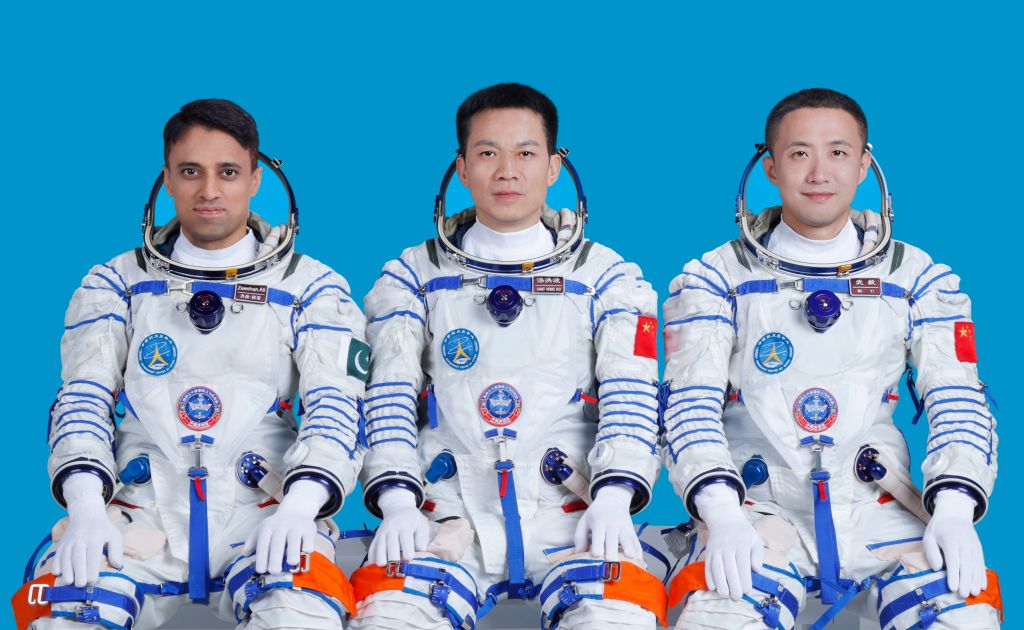
JIUQUAN, China — At 2:35 p.m. Beijing time on Wednesday, the crew already aboard China’s Tiangong space station opened the hatch and welcomed three new arrivals. Among them was Muhammad Zeeshan Ali, a 40-year-old former Pakistan Air Force pilot. He is the first foreign astronaut to board the Chinese outpost, and the first Pakistani in orbit.
Ali flew as a payload specialist on the Shenzhou-24 spacecraft with commander Tang Hongbo and flight engineer Wu Yi. Their Long March-2F rocket lifted off at 8:18 a.m. (00:18 GMT) from the Jiuquan Satellite Launch Center in northwest China, under a pink sky at the edge of the Gobi Desert. About ten minutes later the China Manned Space Agency (CMSA) declared the launch “a complete success.” The spacecraft docked automatically with the front port of Tiangong’s Tianhe core module at 11:56 a.m., after a flight of about three and a half hours.
Once inside, the new crew met the three Shenzhou-23 astronauts who have been in orbit since May. The two crews posed for photographs of what the CMSA called the ninth “space get-together” in China’s spaceflight history, then began the handover.
A short stay, and a year-long experiment
Ali is expected to remain on Tiangong for five to 10 days, Reuters and Al Jazeera reported, before returning to Earth on the Shenzhou-23 spacecraft with two of that mission’s astronauts, Zhang Zhiyuan and Li Jiaying. The CMSA has described his visit only as a short-term joint flight. Tang and Wu will stay for about six months, together with Shenzhou-23 astronaut Zhu Yangzhu, who has already spent half a year in orbit and will remain to complete a year-long stay, the first of its kind in China’s programme. Tang is making his third visit to Tiangong, becoming the first astronaut to do so, the CMSA said. For Wu and Ali, it is a first flight.
CMSA spokesperson Zhang Jingbo said Ali would take part in routine crew work and focus on joint China-Pakistan experiments, mainly installing samples and running tests in orbit. Four cooperative projects in biotechnology and materials science are planned, he said, and Ali will also carry out an experiment on photosynthetic cyanobacteria.
Pakistan’s space agency, the Space and Upper Atmosphere Research Commission (SUPARCO), said the Pakistani experiments include tests of lightweight radiation-shielding composites and self-healing carbon-fibre materials, as well as studies of how microgravity and radiation affect quinoa seeds and the cultivation of microalgae and cyanobacteria as a possible source of food and oxygen. The CMSA said the Shenzhou-24 mission as a whole, which will continue for months after Ali returns, is due to conduct around 90 experiments, including work in aerospace medicine and combustion.
“Not a finish line”
Ali, who was selected in April 2026 and trained at the Astronaut Center of China, appeared before reporters at Jiuquan on Tuesday. “My first flight represents not only myself, but also my country,” he said. Speaking later in Chinese, he quoted the Tang dynasty poet Wang Zhihuan: “To enjoy a grander sight, climb to a greater height.” He added: “This is like my daily training — day after day, climbing to a greater height.”
At the launch centre he told reporters he was “carrying the name of Pakistan on my shoulder, the hopes of 250 million Pakistanis,” the BBC reported. He has described learning Chinese as one of the hardest parts of his training. A second Pakistani candidate, Khurram Daud, trained with him and remained on the ground as backup.
“This mission is not a finish line; it is a launchpad,” Ali said. He hoped future China-Pakistan cooperation would grow “from one astronaut, one flight to multiple joint flights to moon, Mars and beyond.”
A deal signed in Islamabad
The flight has its roots in an agreement signed on 28 February 2025 in Islamabad by the China Manned Space Engineering Office and SUPARCO, in the presence of Prime Minister Shehbaz Sharif. It was the first time China had offered to select and train international astronauts for missions to its station. Under the deal, one Pakistani would fly a short mission to Tiangong after training in China.
The mission also falls in the 75th year of diplomatic relations between the two countries. Sharif said Pakistan had begun its journey “beyond the stars,” and that the voyage “was not just that of one astronaut but of 240 million Pakistanis, particularly the younger generation, scientists and their dreams.” Deputy Prime Minister Ishaq Dar thanked President Xi Jinping and called the flight “a significant milestone in our all-weather strategic cooperative partnership.”
China’s invitation, and what it means in Africa
For Beijing, the flight is a diplomatic event as much as a scientific one. Chinese astronauts have never flown to the International Space Station, which is approaching retirement, and China has spent years building Tiangong and rotating three-person crews through it every six months. Officials now present the station as an international research platform rather than an exclusively Chinese facility. Zhang said China looked forward to “working with more countries and regions.” The BBC reported that Beijing also aims to land its own astronauts on the moon by 2030. Other programmes are racing to put new hardware in orbit, including Google’s plan to test AI computers in space.
The same outreach has already reached Africa, though so far in satellites rather than crews, alongside a wider Chinese technology presence that includes telecoms networks. Ethiopia’s first satellite, ETRSS-1, was launched from China in December 2019. It is a remote-sensing craft whose ground station sits at the Entoto Observatory in the hills above Addis Ababa. Ethiopian engineers were trained on the project and have operated the satellite themselves. Egypt, one of China’s closest space partners on the continent, launched MisrSat-2 on a Chinese rocket in December 2023 and, with Chinese help, built an assembly, integration and testing centre at Egypt Space City, so that later satellites can be put together on Egyptian soil.
China has not announced an African astronaut for Tiangong. For African space programmes that have already worked with Beijing on satellites, Wednesday’s flight is a reminder that it is now also offering something the continent has not yet received: a seat on a space station.