
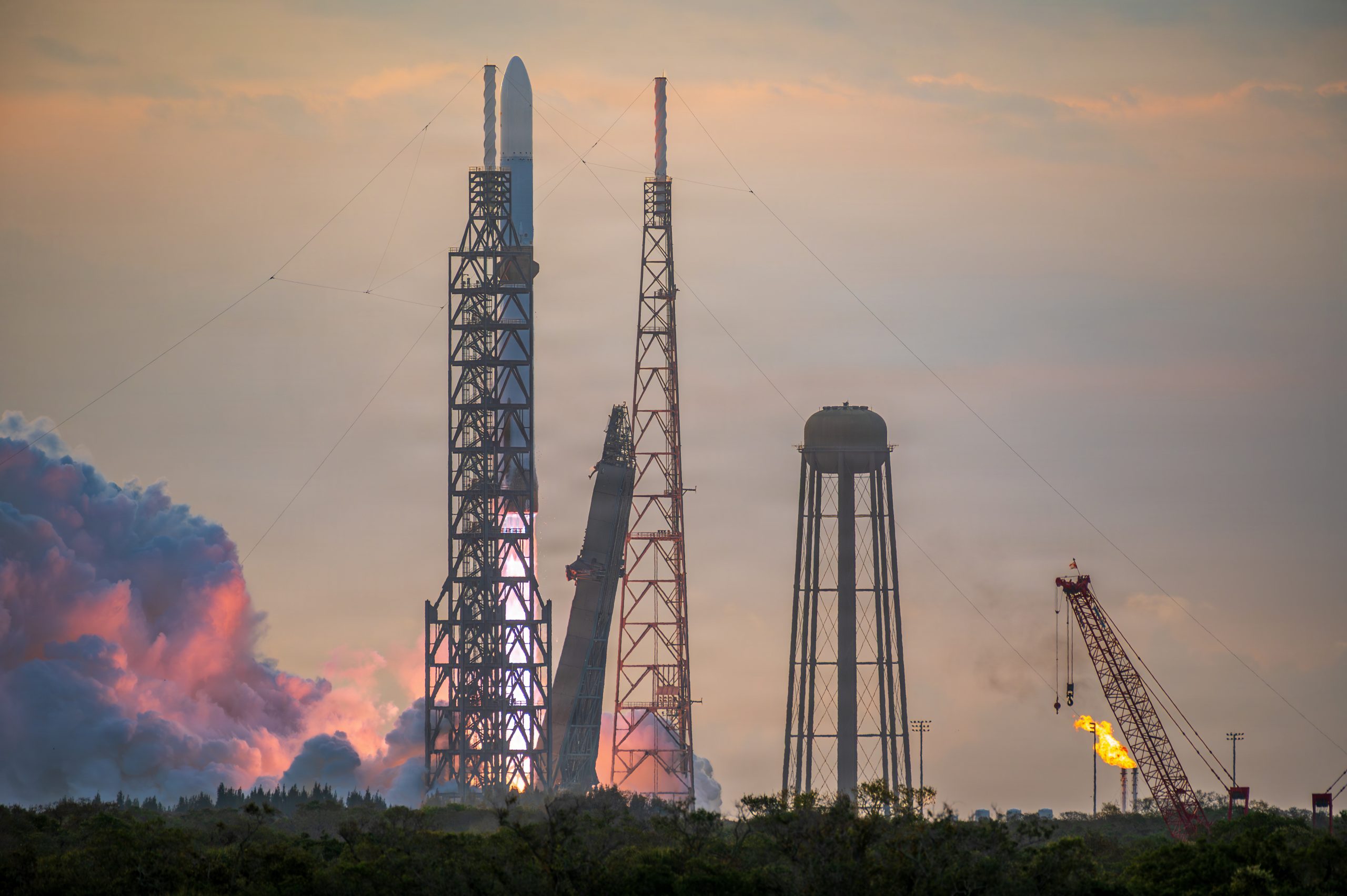
Blue Origin and Google have signed a launch services agreement for Project Suncatcher, Google’s research moonshot to test whether an interconnected network of solar-powered satellites carrying its Tensor Processing Units, or TPUs, could scale machine learning in space. The mission, targeted for the first quarter of 2029, will fly on Blue Origin’s New Glenn rocket and will be Google’s first dedicated heavy-lift launch for the project, both companies said on Thursday.
Blue Origin posted the news on its website and on X. Google published a matching research blog the same day. SpaceNews, The Verge and Reuters also reported the agreement. Neither company disclosed a price, a number of satellites or other financial terms.
The flight is designed to put the satellites into sun-synchronous orbit, each with computing capacity “at roughly the scale of a data center rack,” Blue Origin said. Google used almost the same wording, describing satellites “each with roughly the capacity of a data center rack.”
“Project Suncatcher represents the ambitious missions New Glenn was built to support,” said Jordan Charles, Blue Origin’s senior vice president of New Glenn. “Its heavy-lift capacity and large payload volume give customers the flexibility to bring new capabilities to orbit. We’re proud to work with Google to explore space-based computing and its potential to expand the space economy.”
Travis Beals, senior director of Project Suncatcher at Google, said the project is “a long-term moonshot to scale AI infrastructure in space by tapping into the abundant solar power in orbit.” The dedicated launch, he said, “represents a crucial milestone on our roadmap as we expand the boundaries of what’s possible for the future of compute.”
Google added that the booking “builds on our ongoing work with other satellite and launch partners,” language that presents the New Glenn flight as a first dedicated heavy-lift, not as an exclusive launch contract.
The 2029 mission comes later on a roadmap that has already begun. Google and Planet Labs launched a first Project Suncatcher prototype on 1 October aboard SpaceX’s Transporter-18 rideshare mission, Google said at the time. Later that month, Google reported that the satellite had run its Gemma 4 model in orbit and returned a short haiku to a ground station in Svalbard, Norway, a milestone HahuPrime also covered. Google then said the next step was “twin interconnected satellites in 2027.” In an earlier announcement, Planet said it would build and operate two prototype satellites for Google, “targeting a launch by early 2027,” to test the chips in orbit and high-bandwidth links between the pair.
Thursday’s releases do not say whether the New Glenn flight planned for early 2029 is that twin mission, a later cluster, or something else. Both companies describe the launch as targeted for the first quarter of 2029, a reservation rather than a firm countdown.
Sources
- Blue Origin on X, 19 November 2026
- Blue Origin – Google Selects Blue Origin’s New Glenn for Project Suncatcher
- Google blog – Partnering with Blue Origin on the first heavy-lift Project Suncatcher launch
- SpaceNews – New Glenn to launch Project Suncatcher data center satellites for Google
- The Verge – Blue Origin will launch Google’s AI server satellites in 2029
- Reuters, via Investing.com – Google picks Blue Origin to launch AI computing satellites in 2029
- Google blog – Project Suncatcher prototype satellite is in orbit, 1 October 2026
- Google blog – First response from the Project Suncatcher prototype, 30 October 2026
- Planet Labs – Two prototype satellites targeting a launch by early 2027