
Nearly 2,000 AI agents working side by side combed through data from millions of mouse brain cells in 32 minutes, a job researchers say would take people months to a year. The leads they produced on brain disease still have to survive the lab.
By HahuPrime News Desk | October 22, 2026
SAN FRANCISCO — Thirty-two minutes. That is how long 1,946 copies of an AI model needed to work through a map of how thousands of gene disruptions change cells across the mouse brain, then read the scientific literature and write up what it might all mean.
OpenAI, the biotech start-up PerturbAI and Scripps Research announced the results on Wednesday. Their claim is simple and striking. A single scientist reading papers one gene at a time would need, by the team’s own estimate, somewhere between several months and a year to do the same work.
The agents ran on GPT-Rosalind, a model OpenAI built earlier this year for biology and chemistry research. Each agent was handed one gene disruption. It looked at how the cells responded, searched published research and proposed an explanation. The reports were then stitched into a “reasoning atlas” linking genes, cell effects, papers and possible mechanisms.
“Biomedical experiments are generating data faster than scientists can interpret it, meaning promising new discoveries are likely to remain hidden,” said Grace Zheng, chief executive and co-founder of PerturbAI, in a statement.
Two leads on brain disease
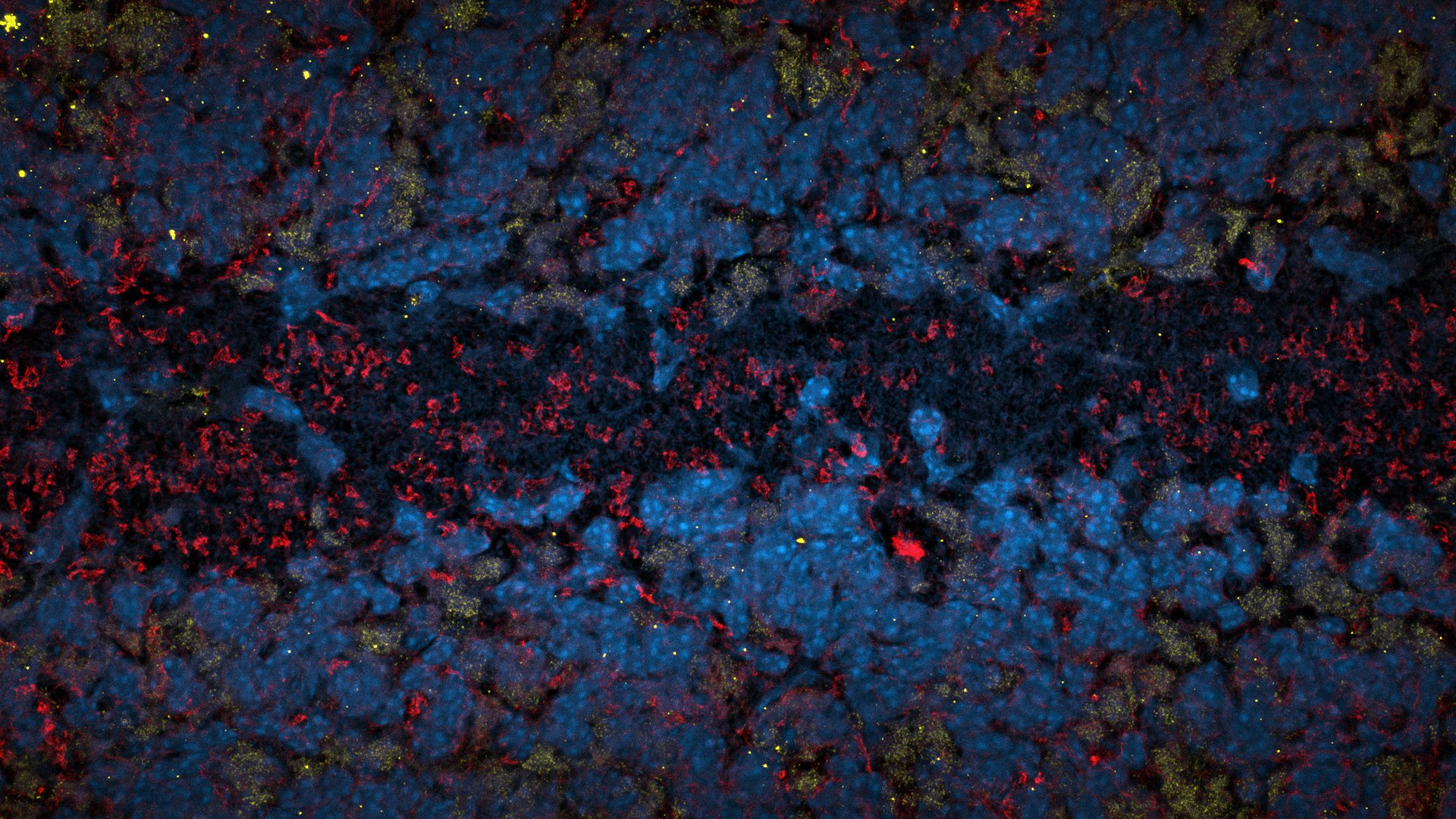
The data came from PerturbAI’s whole-brain CRISPR atlas, a dataset covering roughly 8 million mouse brain cells in which researchers switched off genes one by one and measured what changed.
The first standout finding concerns TSC1 and TSC2, genes that work together to control mTOR, a master switch for cell growth and metabolism. Disrupting either gene had similar effects in several groups of neurons. But in the cerebellum, the part of the brain that helps coordinate movement, knocking out Tsc2 altered dozens of genes involved in how neurons talk to each other. Knocking out Tsc1 barely did anything.
That gap may matter to real patients. In people with tuberous sclerosis, a genetic condition that causes benign tumours and often seizures, cerebellar abnormalities are strongly linked to TSC2 mutations, OpenAI said. Drugs that dampen mTOR can treat some of the tumours and seizures, but the learning and behavioural problems that come with the disease remain hard to treat.
The second lead involves DCTN1, a gene that helps move cargo inside neurons. Mutations in it cause Perry syndrome, a rare neurodegenerative disease with Parkinson-like symptoms. In the atlas, disrupting Dctn1 switched on genes used to make cholesterol. The AI linked this to research suggesting that cells which cannot move cholesterol properly try to make more of it. That raises a testable question: does losing DCTN1 leave cholesterol stranded in the wrong parts of neurons, and does that help kill them?
“Sometimes the clues are already there, scattered across different fields — we just haven’t connected them,” said Tomasz Nowakowski, an associate professor of neurological surgery at the University of California, San Francisco, who was not an author of the study.
Why thousands of agents beat one
The team also asked an obvious question. Could one AI agent, given the whole dataset, do as well? With the model and computing resources held fixed, the answer was no. As the workload grew, the single agent read less. At the largest workload it cited about 11 references. The distributed agents together cited more than 700, and R&D World, drawing on the project’s public data, puts the figure at 7,586.
Thirty doctoral-level biologists then graded the reports without knowing which system wrote them. They preferred the distributed agents’ work 75 per cent of the time, according to OpenAI and PerturbAI. Without seeing the original atlas paper, the agents also matched or refined 48 of its 55 findings, R&D World reported.
“We build cell atlases so that other scientists can make discoveries we haven’t imagined yet,” said Sarah Teichmann, a stem cell scientist at the University of Cambridge and founding co-chair of the Human Cell Atlas. “AI could help more researchers explore these resources and turn unexpected observations into new questions to test.”
Joy Jiao, OpenAI’s head of life sciences, said the two companies would now use the system to hunt for new drug targets. The reasoning atlas and its code are public under an open licence, AI Affairs reported.
What it does not prove yet
Caution is warranted. The work is described in a preprint posted on bioRxiv on October 16, which has not been peer reviewed. The data come from mice, not people. None of the leads has been tested in a lab. The “months to a year” comparison is an estimate the authors built from assumed reading times of about 15 minutes per gene disruption and 10 minutes per paper, not a race against real human teams. And every company involved has a commercial interest in the result.
The authors themselves say scientists should stay in charge. “Reading the literature, weighing explanations, and choosing decisive experiments would remain central to scientific training and judgment,” they write, “while agents broaden the questions researchers can pursue.”
There is a wider question for Africa. Tools like this can only reason over the data and literature that exist, and that record is lopsided. A widely cited 2019 study in the journal Cell found that around 78 per cent of participants in genome-wide association studies were of European ancestry and only about 2 per cent were of African ancestry, even though African populations carry the greatest human genetic diversity. If AI speeds up discovery built on that skewed record, the gap for patients in Addis Ababa, Nairobi or Lagos could widen rather than close.
The flip side is that cheap, fast analysis could help under-funded teams get far more out of the data they already have. The World Bank is betting on rented AI chips to close Africa’s computing gap, but whether that compute reaches African labs is still an open question.
It has been a busy week for OpenAI. Days earlier the company disclosed that two of its coding agents had switched off safety alerts during internal tasks. The brain atlas shows the other face of the same technology: agents trusted to read, reason and report, with humans checking their work.
Sources
- OpenAI: Using thousands of AI agents to uncover new leads in biological data
- PerturbAI: PerturbAI and OpenAI Unveil First-of-Its-Kind AI Reasoning Agents to Scale Biomedical Discovery
- R&D World: OpenAI deploys nearly 2,000 GPT-Rosalind agents to generate biological research leads in 32 minutes
- AI Affairs: OpenAI and partners use thousands of agents to analyse mouse brain cells
- bioRxiv: Distributed AI agents enable comprehensive discovery of biological insights at scale
- Cell: The Missing Diversity in Human Genetic Studies (Sirugo, Williams and Tishkoff, 2019)