
The Saudi-led coalition struck Yemen’s Red Sea port of Hodeidah on Friday, hours after Houthi forces damaged Riyadh’s tallest tower. The Houthis had warned they would target Saudi ports if the attack went ahead.
By HahuPrime News Desk | November 20, 2026
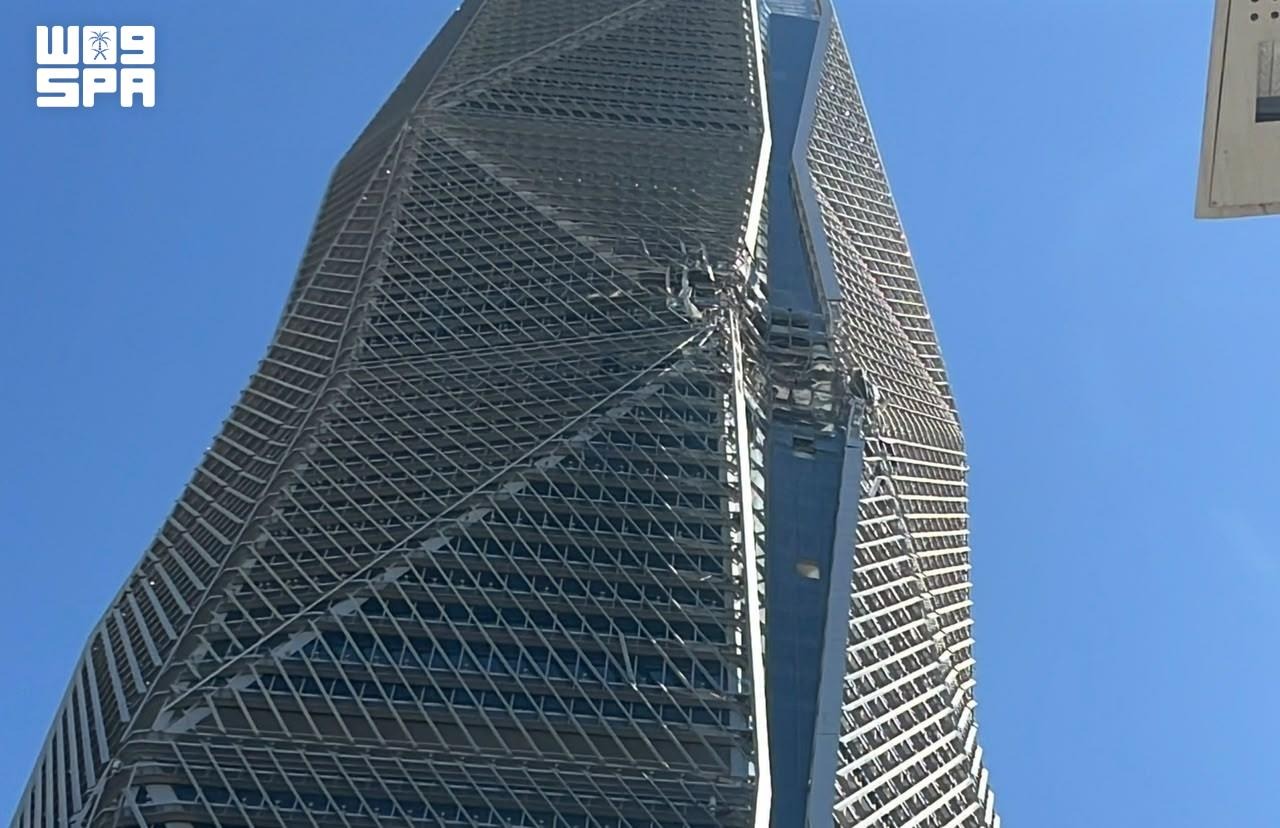
RIYADH — From the pavement, the wound in the tower is plain. A section of the Public Investment Fund Tower’s metal lattice is torn open against a hard blue sky, windows blown out across several floors of Riyadh’s tallest building. Saudi civil defence released the photograph on Thursday and said a Houthi attack had caused material damage to the tower and nearby buildings in the King Abdullah Financial District. No injuries were reported.
The building, 385 metres high and some 80 storeys, houses the headquarters of the Public Investment Fund, the sovereign wealth fund chaired by Crown Prince Mohammed bin Salman. Reuters reported that the strike blew out windows across seven to eight floors and bent parts of the facade, and that the district was closed to visitors. Three sources familiar with the matter told the agency the tower had been hit by an incoming missile. The Saudi-led coalition said it had “dealt with a missile threat” launched towards the capital and that debris had fallen.
On Friday the war moved back to the Red Sea. The coalition, which backs Yemen’s internationally recognised government, first told civilians to leave parts of Hodeidah port, the main harbour on Yemen’s western coast, under Houthi control since 2014 and a lifeline for aid. Houthi military spokesman Yahya Saree then said that Jeddah and all Saudi ports on the Red Sea would become “targets” if the coalition struck Hodeidah.
“We warn all employees, workers, and those in the vicinity of [Saudi Arabia’s Red Sea] ports to evacuate them immediately and stay away. We also urge all shipping companies to immediately evacuate their ships from these ports,” Saree said, according to Al Jazeera. Airlines, he added, should avoid Saudi airspace “because it will be the scene of our operations in the coming hours,” except near Mecca and Medina. He also threatened a power station at Shuqaiq, in the south of the kingdom.
The coalition opens a new operation
Shortly afterwards, coalition spokesman Major General Turki al-Malki said a “targeted operation” had begun. In a statement carried by the official Saudi Press Agency, he said the coalition had targeted “operational capabilities at the port of Hodeidah, which facilitated the smuggling and transport of weapons and ballistic missiles.” The operation, he added, was continuing against military targets and ballistic capabilities in Sanaa, Saada and Taiz.
In a later statement, al-Malki said seven “legitimate military targets” had been destroyed, along with six workshops used to assemble missile launchers and drones, and that a supply depot in Sanaa had been “neutralized.” Those claims have not been independently verified. The National, citing the spokesman, reported that air defences later intercepted two ballistic missiles headed for the Jazan region, with debris falling near Al Shuqaiq. A strike on the power station Saree named was not confirmed.
From Sanaa, Al Jazeera correspondent Yousef Mawry said Friday’s raids were among the heaviest since the present fighting began. Independent accounts of what was hit at the port, and of any civilian casualties there on Friday, were not established by evening.
A tower, and a war that restarted in summer
Thursday’s damage in Riyadh was not an isolated blow. The foreign ministry condemned attacks on “civilian and economic facilities” in the capital and said the kingdom “asserts its full and legitimate right to take all necessary measures to defend its sovereignty, protect its national assets, and safeguard the security and safety of its citizens and residents.”
The Houthis said they had targeted the financial centre twice on Thursday, and also claimed attacks on Riyadh’s international airport, Khamis Mushait air base and a petrochemical plant in Jubail. Reuters said there was no immediate Saudi confirmation of those additional claims. A Houthi attack on 8 November had already damaged the Aramco building in the same district.
Saudi Arabia entered the Yemen war in 2015. A UN-brokered truce largely froze it in 2022, before fighting reignited this summer. An attack on Riyadh’s airport in October killed people on the ground; Al Jazeera, citing authorities, said 18 died over four days, while AFP reported a strike that killed 14. HahuPrime has previously reported on Saudi vows of a firm reply after earlier strikes and on Houthi threats of deeper attacks.
The Red Sea and a deepening humanitarian crisis
Hodeidah matters beyond Yemen. The port sits on the eastern shore of the Red Sea, on the route that links Asia to the Suez Canal. Reuters reported that the Houthis have seized Yemen’s entire Red Sea coast, including the Bab el-Mandeb Strait, and have surrounded Taiz, which overlooks Aden, the government’s temporary capital. The National said some estimates put Houthi forces about 100 kilometres from Aden, with water and fuel short in Taiz. Those claims are still being tested, but Reuters said the ground war has favoured the Houthis, forcing a major retreat by government forces at the weekend.
The human cost is already severe. UNICEF said this week that more than 330,000 people, including an estimated 174,000 children, have been displaced since the fighting intensified, with the heaviest movements in Taiz and Lahij. The World Health Organization, as reported by Al Jazeera, said the death toll from the escalation that began in August had reached 2,260, with 10,519 wounded, as of 16 November. Hodeidah remains a UN-verified entry point for aid even as it is fought over.
Egypt has already authorised military support for Saudi Arabia, a step HahuPrime reported when Cairo’s parliament approved the measure. The immediate danger is now on the water: a port the coalition says is used to move missiles, and a sea lane on which much of the world’s trade still depends.
Sources
- Saudi Press Agency: Turki al-Malki coalition statements, 20 November 2026; Civil Defence and Foreign Ministry, 19 November 2026
- Reuters, via NBC News, on the 19 November PIF Tower strike
- Al Jazeera, with AFP and Reuters, 20 November 2026
- The National, 20 November 2026; UNICEF Yemen updates; WHO figures as reported by Al Jazeera