
The World Bank Group on Tuesday launched its first digital strategy and a plan to give governments in Africa and Latin America shared, pay-as-you-go access to AI chips. It has not yet said which countries will take part, what the service will cost or when it will start.
By HahuPrime News Desk | October 20, 2026
SEOUL — When Strive Masiyiwa travelled to Silicon Valley last year to buy chips from Nvidia, he says he was given a startling number. “They told us there were only 80 Nvidia GPUs on the African continent,” the Zimbabwean billionaire told the Africa Tech Festival in Cape Town in November 2025, recalling a meeting with Nvidia founder Jensen Huang. “I said ‘Mr. Huang, I wanted 12,000.'” His count for the continent has not been independently verified. But it captures a gap that the world’s biggest development lender now says it wants to help close.
On Tuesday, at a summit in Seoul, the World Bank Group launched its first digital strategy and, alongside it, an AI Infrastructure and Readiness Initiative. Instead of each government building its own national data centre, countries would share computing power and pay as they go for the graphics processing units (GPUs) used to build and run AI tools. Africa and Latin America come first. Masiyiwa’s Cassava Technologies and Nvidia are named as “knowledge partners”.
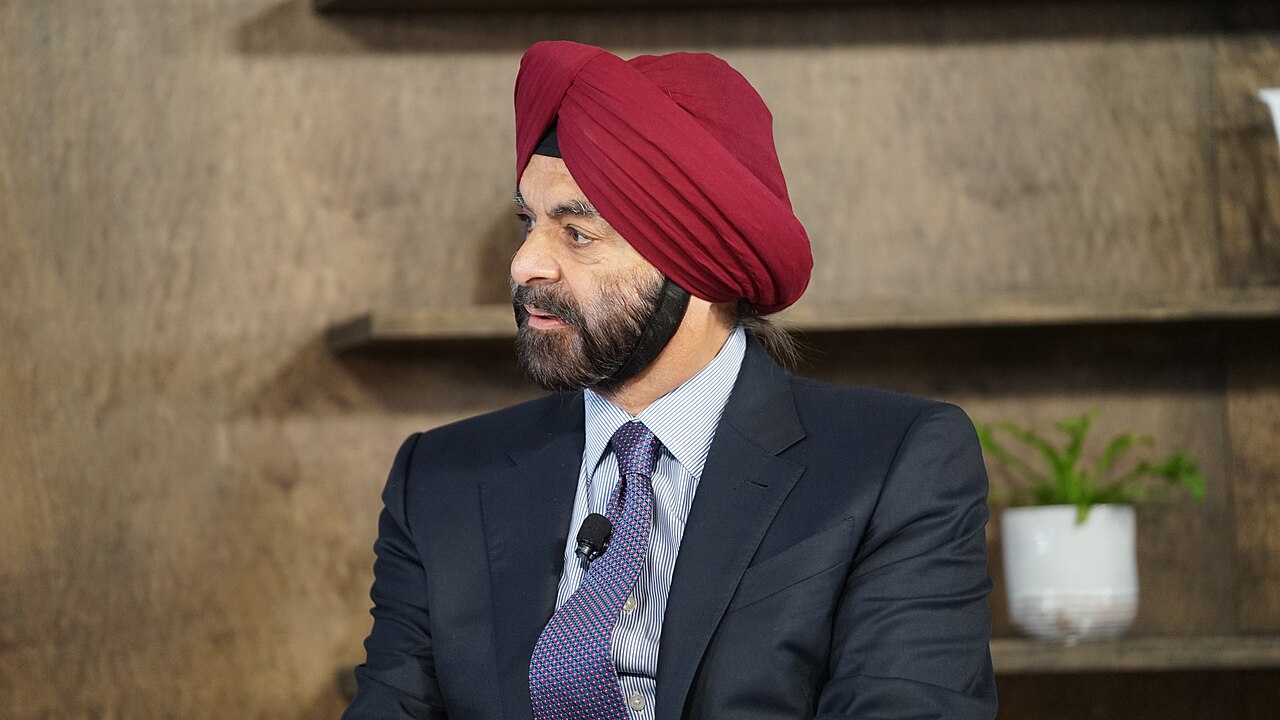
“Digital technology can help countries create jobs and make scarce resources go further,” World Bank Group President Ajay Banga said in the bank’s statement. “Our first digital strategy brings these pieces together, helping countries build the foundations to benefit from today’s digital tools and the promise of small AI—AI for the people.”
What the World Bank is promising
The strategy rests on four priorities: wider connectivity, cheaper devices and data, digital services and skills, and readiness for AI. Its own numbers are stark. Only 23 percent of people in low-income countries used the internet in 2025, against 94 percent in high-income countries, the bank says. Over the next 10 to 15 years, 1.2 billion young people will reach working age in developing countries, whose economies are projected to create about 420 million jobs.
Banga told reporters the bank aims to bring broadband to 600 million people and online services to 400 million more, The Herald Business reported; Maeil Business Newspaper put the deadline at 2030. “If we don’t take into account the needs of developing countries in the AI revolution, they could be left behind,” he said. “We will not just look at the problem — we will act to solve it.”
What is missing matters as much. The bank’s statement names no participating countries, no price for computing time, no funding amount and no start date. Nor does it say where the shared GPUs would physically sit.
Why “small AI”, and why now
The bank is not pitching giant chatbots. It wants “small AI”: tools built for one task and local conditions, such as spotting crop disease or helping shops manage stock. Summit material describes models that run on basic phones, cope with weak connections and reach people through SMS and voice.
In Seoul, Banga pointed to an app that lets farmers in India identify crop diseases with their phones and a tool that assesses Spanish pronunciation among primary school pupils in El Salvador, The Herald Business reported. He also said he had asked Samsung about refurbishing old phones for poorer countries, “since phone prices are just too high right now”.
The timing is telling. On Monday Banga said big technology firms were pouring money into large data centres, but “bond markets are raising questions about whether the business models of those data centers are viable.” He predicted “some correction”. A shared, rented model is partly a hedge: governments would not be left holding costly buildings full of chips that age fast.
He also said AI would cause “some degree of labor market disruption”, though in low-income countries he expects it to assist teachers, farmers and health workers rather than replace them. That debate is already live in the region. HahuPrime reported earlier today that Microsoft has wound down its Nairobi engineering hub, and on Saturday on how AI agents are shrinking junior hiring at Anthropic.
The compute gap Africa is trying to close
The shortage is not abstract. A 2024 analysis of about 11,000 data scientists on Zindi, the continent’s largest AI talent network, found that only 5 percent had access to the computing power needed for serious work. “With only five percent of Africa’s AI talent having access to the computational power and resources needed to carry out complex tasks… we must act now to change this trajectory,” Zindi founder Celina Lee and Alliance4ai co-founder Alexander Tsado wrote in a UNDP blog. They estimated that an African team might wait up to six days between model changes that a G7 startup could make every 30 minutes.
Cassava has been trying to fill part of that gap commercially, launching what it called Africa’s first GPU-as-a-service in November 2025 and an Nvidia-powered “AI Factory” in South Africa in March, with Nigeria, Kenya, Egypt and Morocco to follow. “Our goal is to give Africa the infrastructure to write its own future, using its own languages,” said Ahmed El Beheiry, Cassava’s chief technology and AI officer,.
That raises a question the bank has not answered. Cassava argues computing should stay inside Africa so African data does too, yet a shared regional pool will not sit in every borrower’s territory.
What it could mean for Ethiopia
For Ethiopia, the bottleneck may be the pipe rather than the chip. Renting a distant GPU only helps if the connection holds. Ethiopia ranked 113th of 119 countries for real-world browser speeds in Speedtest data for March 2026, with a median download speed of 4.5Mbps, Addis Fortune reported. HahuPrime has also covered Wingu Africa’s cloud exchange launch in Ethiopia.
Ethiopia is further along on another of the bank’s priorities, digital identity. The Fayda national ID has passed 52.9 million enrolments, and FaydaVerse now charges banks 5 to 10 US cents per verification, Capital Ethiopia and Biometric Update reported.
The Seoul summit runs until Thursday. Until the bank names countries, prices and dates, its AI initiative is a promise of access rather than access itself.
Sources
- World Bank: World Bank Group Launches First Digital Strategy to Expand Access and Create Jobs
- World Bank: Global AI and Digital Summit 2026
- The Herald Business: World Bank chief praises South Korea’s future response fund amid AI investment shift
- Maeil Business Newspaper: We are also discussing investment in developing countries with Korean companies in the electric vehicle and battery sectors
- TechTrends Kenya: World Bank taps Cassava, Nvidia for Africa AI compute push
- Business Times (Zimbabwe): World Bank Group names Cassava Technologies and NVIDIA knowledge partners in AI initiative
- Connecting Africa: ATF 2025: Cassava launches Africa’s first GPU-as-a-service
- Connecting Africa: Cassava deploys ‘AI Factory’ in SA, more countries in the pipeline
- UNDP: Only five percent of Africa’s AI talent has the compute power it needs
- Addis Fortune: Zergaw Expands Local Cloud Services With Four New Products
- Biometric Update: Ethiopia puts Fayda digital ID verification on a fee-based footing