
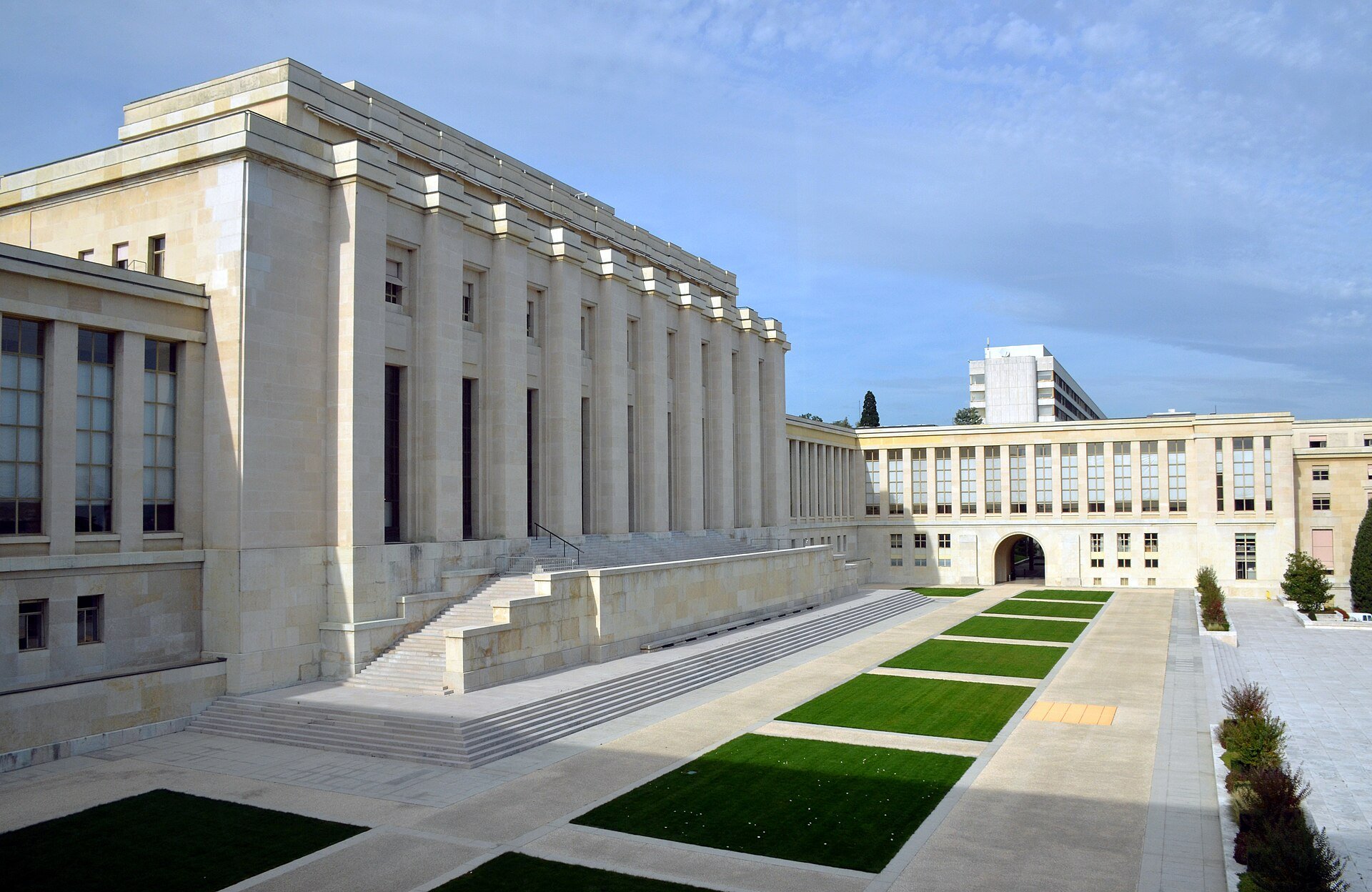
Twenty-one countries and five international bodies met in Geneva to line up their Sudan peace efforts. The two armies fighting the war were not in the room, and the UN envoy called the only agreed steps so far “baby steps”.
By HahuPrime News Desk | October 22, 2026
GENEVA — The last question at the press conference was not really a question. Taha Hassan, a Sudanese reporter for Associated Press Television, told the United Nations envoy at the Palais des Nations on Wednesday that he was speaking “as Sudanese citizen, not a journalist.”
“We are suffering a lot,” he said. “We need to end this war. Please could you give us how can end stop this war in Sudan.”
Pekka Haavisto, the UN Secretary-General’s personal envoy for Sudan, did not offer a date or a deal. He spoke about women’s groups, youth meetings and the gold and smuggling networks that help finance the war. Hours earlier he had told the same room that the only concrete steps on the table were a possible prisoner exchange and a plan to let students across the country sit their 12th-grade exams.
“These are, of course, baby steps compared with the terrible destruction that is happening in the country currently,” Haavisto said, according to the UN’s transcript.
Mediators meet, the warring sides stay away
The sixth Consultative Meeting on Enhancing Coordination of Peace Initiatives and Efforts in Sudan, co-hosted by Switzerland and the UN, brought together 21 countries and five international organisations. They included the United States, Saudi Arabia, the United Arab Emirates and Egypt, the four members of the so-called Quad, along with all five permanent members of the UN Security Council and neighbours including Ethiopia, Eritrea, Chad, Kenya, South Sudan, Uganda and Libya.
Neither the Sudanese Armed Forces (SAF) nor the paramilitary Rapid Support Forces (RSF) took part. That was by design: the forum exists for mediators to coordinate, not to negotiate with the parties. The last round was held in Cairo in January.
The co-chairs’ summary, released after the talks, said participants were gravely concerned about “reports of atrocities and the escalation in drone warfare resulting in the immense suffering of civilians.” They “rejected the establishment of parallel governments, institutions or governance structures,” and urged foreign states and non-state actors to stop fuelling the war “through mercenaries, the provision of military equipment, particularly drones,” and financial support. The document did not name any country.
Alexandre Fasel, Switzerland’s state secretary for foreign affairs, opened the day with a blunter description. “The war in Sudan has become a drone war; it kills mostly civilians,” he said, according to UN News. “Famine-like conditions persist in Darfur, the Kordofan state and elsewhere in the country; it is the war that drives this hunger.”
Fasel cited UN figures showing almost 34 million people in Sudan need humanitarian aid and eight million children are out of school.
What came out of the room
Haavisto argued that the value of the meeting lay in bringing two separate tracks together. The Quad has been pushing for a humanitarian truce and a ceasefire. A second group, the Quintet of the African Union, the regional bloc IGAD, the Arab League, the European Union and the UN, is working on what a political transition would look like. Leaders of the two groups held their first intensive informal talks on Tuesday night, Haavisto said.
“All parties in Sudan conflict are asking that if we agree on a humanitarian truce or if we agree on a ceasefire, how the day after will look like,” he said. “The day after is planned by this political work.”
For the first time, the meeting also gave a session to neighbouring states to describe the burden they carry from the war, mostly in refugees. Participants warned that the risk of regional spillover was rising and that its consequences “could be catastrophic and difficult to reverse.”
No ceasefire text, monitoring plan or timetable came out of Geneva. The co-chairs said a seventh meeting would follow, with “its date, venue and agenda to be determined.”
A war both sides still think they can win
Haavisto was frank about the gap between diplomacy and the front lines. “Unfortunately, we still have in Sudan parties who believe in a military victory of this war,” he said. He also argued that the conflict is “not only war between two generals, General Hemedti and General Burhan, but this is a war between the coalitions,” meaning mediators have to reach the commanders and allied groups below the top leaders.
The army’s leader has made his position public. On October 6, speaking in the northern locality of Merowe, Gen. Abdel Fattah al-Burhan vowed to retake “every inch” of territory held by the RSF and said the “military option” would continue, Al Jazeera reported, citing the Sudan News Agency. The RSF has been massing in West Kordofan as the army pushes towards En Nahud.
The war, which began in April 2023 when the army and the RSF fell out over plans to merge their forces, has killed more than 200,000 people according to aid workers’ estimates cited by AFP. More than 13 million people have been forced from their homes.
For Sudan’s neighbours the stakes keep climbing. Sudan’s pound has crashed past 10,000 to the dollar, pushing bread out of reach for many families. Drone strikes on the disputed Abyei area have killed more than 220 people. And Ethiopia and Sudan have traded accusations of backing each other’s armed opponents, a quarrel that has already reached the UN Security Council. Both Addis Ababa and Asmara sat at the Geneva table this week while their own relationship, broken off on October 1, remains frozen.
Washington’s line is that Sudanese, not outsiders, must lead. Massad Boulos, the US senior adviser for Arab and African affairs, wrote on X earlier this month that peace could come “through an inclusive Sudanese-owned and Sudanese-led national dialogue, transition toward a civilian-led government.”
Haavisto said the UN would keep pressing the two confidence-building measures, the detainee swap and the exams, because they are “issues that should unite actually the both parties of the conflict.” For the students waiting to sit those exams, and for the reporter who asked his question as a citizen, Geneva produced a promise of another meeting and little else yet.
Sources
- UN Department of Political and Peacebuilding Affairs: Summary of the Co-Chairs of the Sixth Consultative Meeting on Enhancing Coordination of Peace Initiatives and Efforts in Sudan
- UN Department of Political and Peacebuilding Affairs: Transcript of Pekka Haavisto’s remarks at the press conference following the 6th Consultative Meeting
- UN News: Sudan conflict: Peace efforts resume to end ‘drone war’ fuelling humanitarian crisis
- AFP via Arab News: No military solution in Sudan: UN envoy
- Keystone-SDA via swissinfo.ch: UN Geneva meeting to coordinate Sudan peace efforts
- Al Jazeera: Sudan’s al-Burhan rejects talks, vows to retake all territory from RSF