
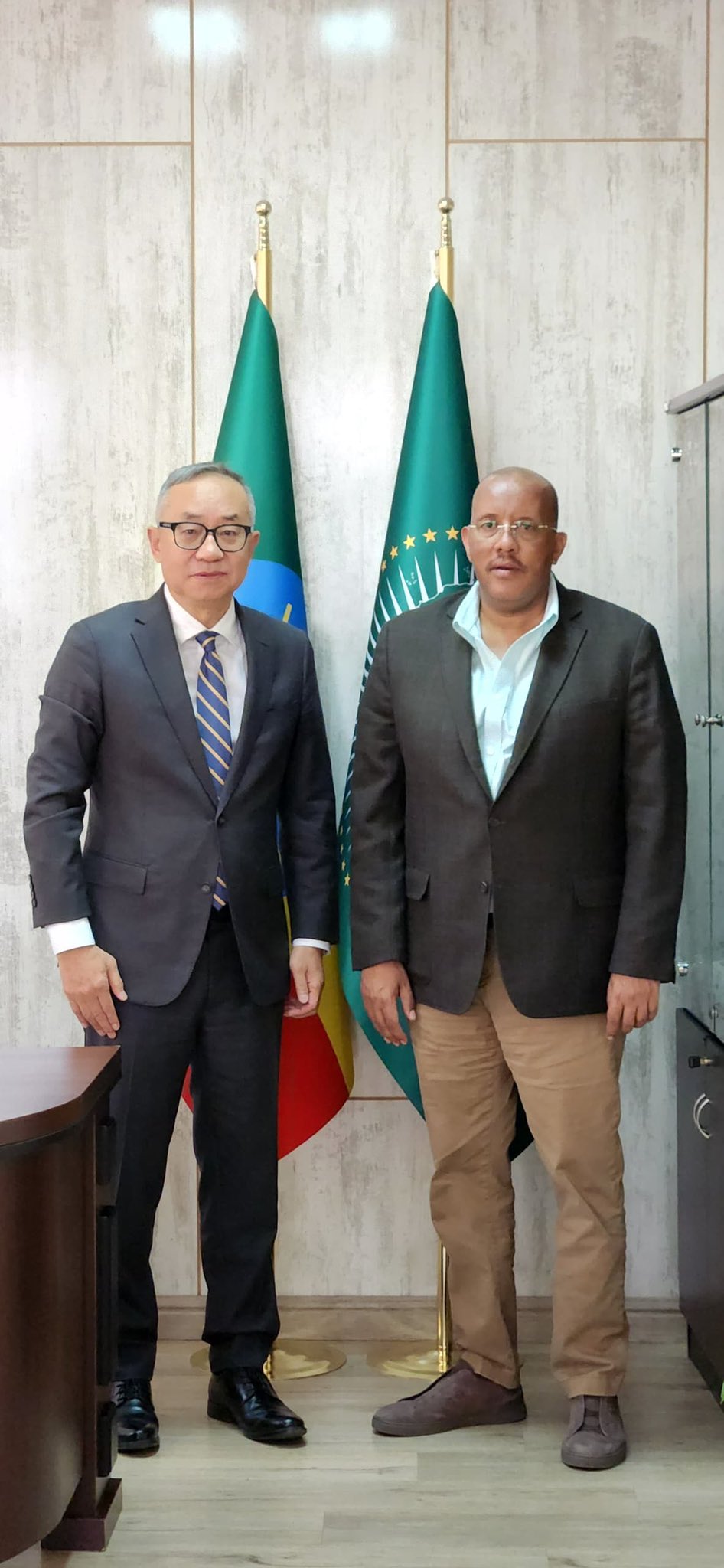
Getachew Reda used a meeting with the UN’s Horn of Africa envoy to seek help for Tigray’s new caretaker government and to warn about Asmara. Hours later, Eritrea’s foreign ministry published a paper rejecting the “both sides” language that most mediators use.
By HahuPrime News Desk | October 21, 2026
ADDIS ABABA — At 6:20 on Wednesday morning, an Ethiopian military jet flew low over Mekelle. The noise frightened residents of the Tigray capital, according to the conflict monitor ACLED. Tigray Television, now under government control, said it was routine monitoring and posed no military threat. Later that day, the fight moved to statements.
In Addis Ababa, Getachew Reda, Prime Minister Abiy Ahmed’s minister and adviser on East African affairs, met Guang Cong, the UN Secretary-General’s Special Envoy for the Horn of Africa. In Asmara, Eritrea’s foreign ministry released a position paper that called Ethiopia’s invasion accusations “entirely fabricated”. It also told the international community that its even-handed calls for restraint were part of the problem.
Neither side is talking to the other. Both are talking to the world.
Getachew asks the UN to back Tigray’s caretakers
Getachew described the meeting in a post on X. The talks, he wrote, “focused on the conflict in Sudan, coming elections in South Sudan, Somalia and more importantly on the situation in Tigray.”
“I briefed the Special Envoy on the developments that unfolded since the 23rd of September and potential role for the UN in supporting the newly established Caretaker Administration,” he said, according to the statement reported by Horn Diplomat. He named rehabilitation, humanitarian aid and the return of internally displaced people as the areas where Tigray most needs outside help.
He then turned to Eritrea. “I also underlined the need for the international community to be mindful of the destructive role the Regime in Asmara had and continues to have in destabilizing the entire region and Ethiopia in particular,” Getachew said.
He said the envoy promised “to do all he can for the UN to play a meaningful role.” The UN had not published its own account by Wednesday evening.
The caretaker administration Getachew wants the UN to support was set up on October 16 under a Council of Ministers regulation, after a decision by the House of Federation. It has six months to restore services, help displaced people go home, oversee disarmament and prepare for elections, all under federal supervision.
Money is short. On Wednesday the UN humanitarian office, OCHA, warned that 10 of the 16 mobile health and nutrition teams in neighbouring Amhara are expected to stop working by the end of October for lack of funding.
Asmara rejects the “both sides” formula
Eritrea’s paper, titled “Eritrea’s Principled Position Regarding the Ongoing Situation with Ethiopia” and published by the Ministry of Information, took the opposite view on nearly every point.
It described Eritrea’s sovereignty as “non-negotiable, inviolable, and sacrosanct” and said there is no “good faith dispute” between the two countries. It blamed the crisis on Ethiopia’s ruling Prosperity Party.
The ministry also took aim at the diplomats trying to cool things down. Generic calls for “all parties” or “both sides” to exercise restraint, it argued, are “legally flawed and diplomatically counterproductive” because they create “a false equivalence” between the two governments. In Asmara’s view, de-escalation can only start once Addis Ababa ends what it calls hostile policies.
On the central factual dispute, the paper said the Eritrean Defence Forces “remains stationed entirely within the internationally recognized borders” of Eritrea. It said reports of Eritrean troops still on Ethiopian soil refer to land awarded to Eritrea by the Eritrea-Ethiopia Boundary Commission in its April 2002 ruling. It added that Eritrea has “zero irredentist claims” on Ethiopian territory but is ready to defend itself.
That account clashes with other reporting. Ethiopia’s foreign minister, Gedion Timothewos, told the UN Security Council in a letter seen by Reuters and AFP on October 9 that Eritrean forces had pushed up to 60 kilometres into Tigray in an “all-out invasion”. AFP later quoted residents who said Eritrean soldiers were still stationed in some Ethiopian border areas as of October 18. HahuPrime could not independently verify troop positions along the border.
A diplomatic contest in New York
Eritrea is making the same case at the United Nations. Its ambassador, Sophia Tesfamariam, said on X on Tuesday that she had held “constructive engagements” with Mike Waltz, the US permanent representative, and Jeffrey Bartos, the US representative for management and reform.
She “reiterated that there is no ‘crisis’ between Eritrea and Ethiopia,” according to Addis Standard, and urged Addis Ababa to “respect Eritrea’s sovereign territories and stop diverting attention from its domestic issues.”
The rhetoric has hardened in both capitals this week. In a Tigrinya-language interview aired on October 19, Abiy warned Eritrea of “very severe consequences” unless it chose cooperation. Information minister Yemane Gebremeskel replied that Ethiopia had taken $80 billion to $90 billion in aid over 35 years without ending hunger.
The quarrel sits on top of a longer one. Ethiopia lost its coastline when Eritrea became independent in 1993, and Abiy has repeatedly said that sovereign access to the Red Sea is an existential issue for his country of more than 120 million people. Addis Ababa says it will pursue that peacefully; Asmara reads it as a threat to its port of Assab. The two fought a border war in 1998-2000, made peace in 2018 and were allies against the Tigray People’s Liberation Front (TPLF) in 2020-22.
US Secretary of State Marco Rubio has already urged Abiy to de-escalate, saying the region could not tolerate more conflict. Eritrea’s paper, in effect, tells mediators like him that the usual neutral wording will not be accepted in Asmara.
On the ground, the Critical Threats Project reported, citing ACLED, that federal troops had pulled back from border towns such as Zalambessa and Rama, while Tigrayan forces kept attacking supply lines in central Tigray.
Getachew wants UN money and attention for a region trying to rebuild under a government it did not elect. Eritrea wants the world to stop treating it as half of the problem. With neither capital talking to the other, the UN envoy may be one of the few people both sides are still willing to brief.
Related HahuPrime coverage: Abiy warns Eritrea of “very severe consequences”, Rubio warns the border buildup risks a wider war and Adigrat residents describe the Eritrean troops’ exit.
Sources
- Getachew Reda on X: Meeting with UN Special Envoy Guang Cong
- Horn Diplomat: Getachew Reda, UN Envoy Discuss Horn of Africa Regional Issues
- Eritrea Ministry of Information: Eritrea’s Principled Position Regarding the Ongoing Situation with Ethiopia
- Addis Standard via allAfrica: Eritrea Tells US There Is No ‘Crisis’ Between Ethiopia and Eritrea
- Reuters via CNBC Africa: Ethiopia says it must defend itself against Eritrea’s ‘all-out invasion’
- Al Jazeera, AFP and AP: Eritrea urges UN to intervene in standoff with Ethiopia
- Ethiopian News Agency: Six-Month Caretaker Administration Established in Tigray Region
- ACLED: Ethiopia Alerts, October 21, 2026
- Critical Threats Project: Ethiopia War Security Review, October 20, 2026
- Dawan Africa: Eritrea Accuses Ethiopia of Aid Dependence