
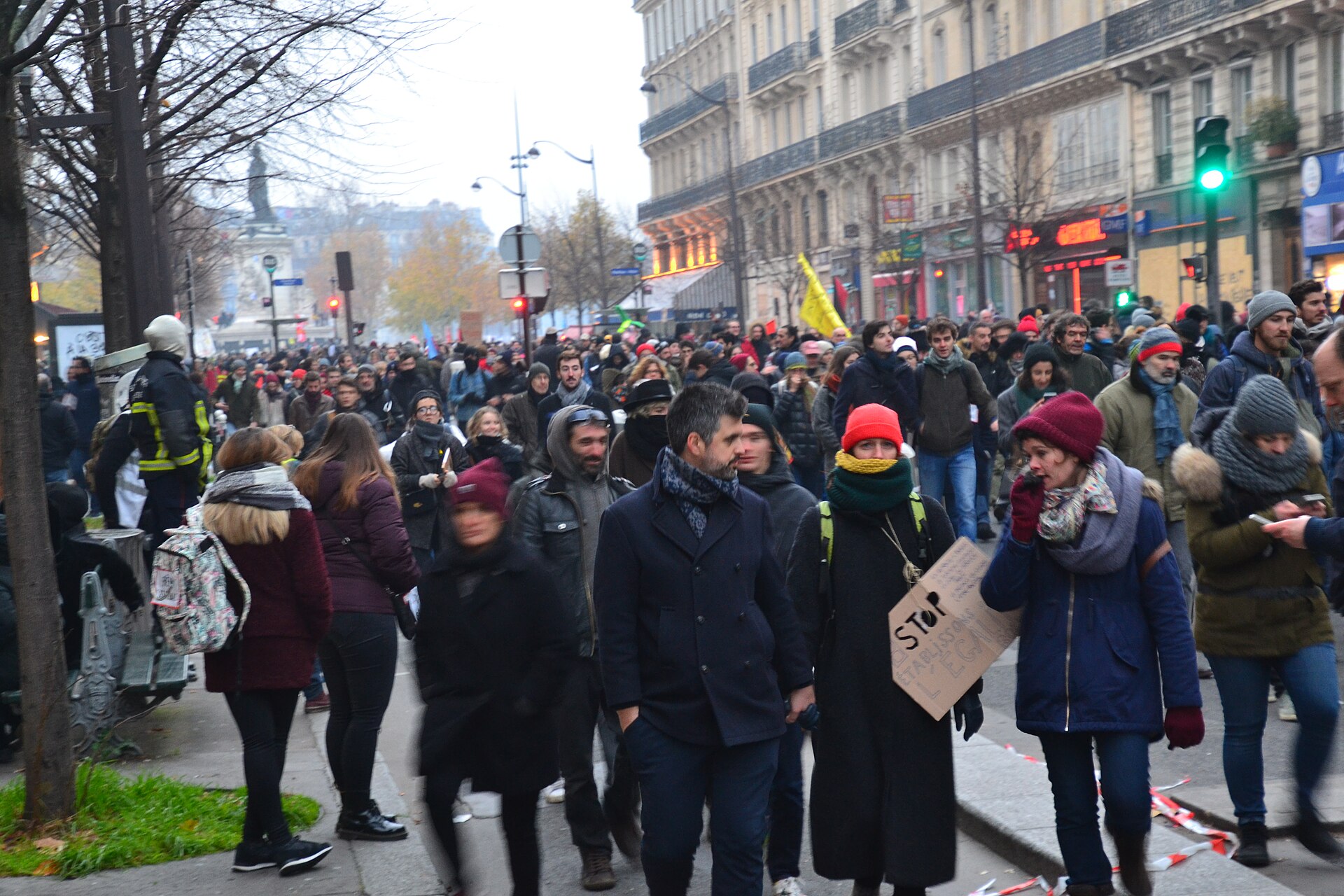
Police fired tear gas and water cannon in Paris, Lyon, Marseille and other French cities on Saturday as tens of thousands joined protests over living costs and schools. The interior ministry reported 272 arrests nationwide.
By HahuPrime News Desk | October 17, 2026
PARIS — In Lyon, masked youths smashed the windows of the city’s tourism office and set it alight. Local police said “hostile individuals” kept firefighters from reaching the blaze. Mayor Grégory Doucet told BFMTV it was “a tragedy” for the city.
The fire was one of the sharpest scenes of a day of France protests that, according to the interior ministry, ended with at least 272 arrests nationwide. Former “yellow vest” activists and student groups had called the demonstrations against high prices, which come after four weeks of high-school protests and six months before the presidential election, AFP reported.
- The interior ministry reported at least 272 arrests nationwide; Paris police said more than 130 of them were in the capital.
- By midday the ministry had counted about 32,800 people at 140 actions outside Paris; organisers listed more than 600 planned demonstrations.
- Protesters entered town halls in Marseille and Lille, and Lyon’s tourism office was set on fire, according to AFP and the ministry.
- President Emmanuel Macron on Friday urged “respect for people and property”. No deaths have been reported.
Clashes in Paris, Marseille and Lille
In Paris, tens of thousands marched through the east and north of the city. The BBC‘s correspondent described the main march, from Place de la République to Place de Clichy, as largely peaceful. Small groups elsewhere built barricades and confronted riot police. AFP journalists saw parked cars set on fire and the broken windows of the broadcasters CNews and Europe 1. Authorities had banned protests near government buildings, the Champs-Elysées and train stations.
In Marseille, protesters used a metal fence to force open the door of the 17th-century city hall and overturned a bust inside before police removed them. Mayor Benoît Payan said the damage was “limited”, according to BFMTV. In Lille, protesters forced their way into the mayor’s office. The ministry also reported damage to Grenoble’s city hall, an intrusion into the prefecture courtyard in Avignon, and vandalised shops in Pau, Montpellier, Toulouse and Valence.
Interior Minister Laurent Nuñez’s office described “an escalation in violence” and blamed “black bloc” groups “centered around far-left elements”. Those claims could not be independently verified. By the ministry’s count, about 20,000 people marched in Lyon, a similar number in Nantes and 10,000 in Rennes, France 24 and the BBC reported.
“At the end of the month, I have nothing left. Prices are going up but wages aren’t.” — Franck, a civil servant marching in Guéret, to AFP
How the France protests spread from schools to prices
The movement began last month in high schools in the poor northern suburbs of Paris, where students protested over teacher shortages and run-down buildings, CNBC reported. It has since spread into anger over inequality and prices. Inflation has risen above 3 percent, and fuel prices have climbed since the US-Iran war began this year, the same shock behind fuel shortages as far away as Ethiopia. French public debt is projected to exceed 120 percent of GDP next year, according to AFP.
Police tactics are part of the anger. A teenager lost a hand after picking up a stun grenade during the student protests, and the police watchdog is examining at least two dozen complaints of police violence, CNBC reported. Prime Minister Sébastien Lecornu has said more than 900 officers have been injured. “We just want to study, we just want a future,” Mariam, a student at Paris 1 Panthéon-Sorbonne University, told the BBC.
The candidates hoping to succeed Macron have given very different accounts of the day. Marine Le Pen of the National Rally, who leads the polls, said on X that “rioters” had “sullied” the demonstrations, which she said had been “hijacked by the far left”. Jean-Luc Mélenchon of France Unbowed wrote that “everything is unfolding in calm” in most marches while television “floods us with images of violence”.
What comes next
Analysis: Saturday showed that school protests and the cost of living can now fill the same streets. It did not show how large the movement is, since police and organisers rarely agree on crowd sizes and full national figures had not been published by Saturday evening. Organisers had not announced a next national date. Abroad, the unrest adds to pressure on a European government already strained by the energy shock, a strain also seen in Spain’s dispute with Washington over the Iran war.
The first round of the presidential election is due in April 2027, with a run-off in May. Until then, Macron’s government faces both movements at once.
Sources
- AFP: Clashes erupt in France as protesters vow to make government ‘tremble’
- BBC News: Protesters clash with police in Paris and across France (live)
- AP: Protests in France against rising living costs
- France 24: Tens of thousands join protests across France (live)
- CNBC: Tear gas, clashes hit French cities in cost-of-living protests