
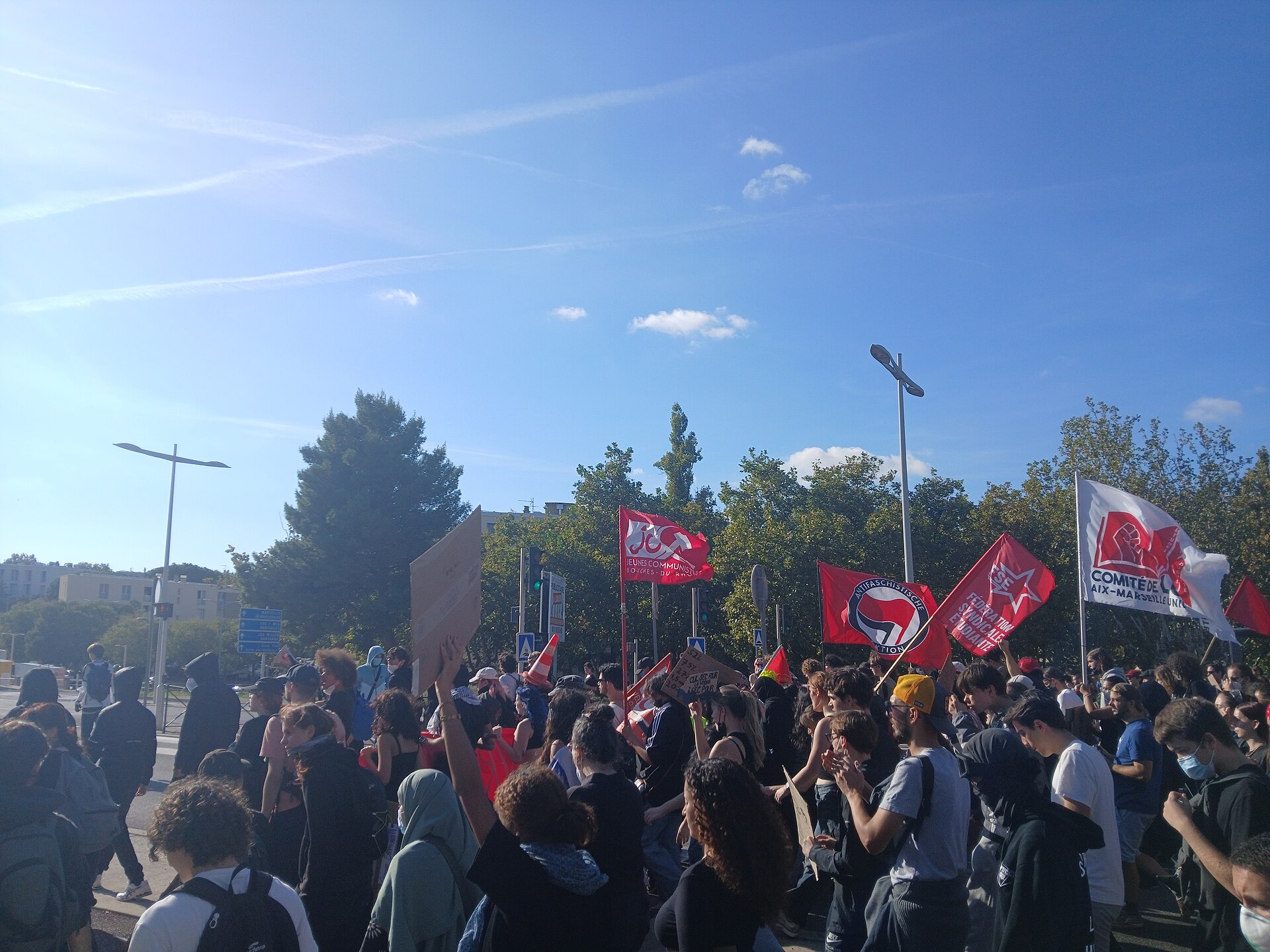
Youths clashed with police in Brussels, Liège, Milan and Bologna on Saturday, and housing protesters camped in Lisbon, on the same day as France’s biggest cost-of-living protests in years. The grievances overlap, but reports so far show separate movements rather than one coordinated campaign.
By HahuPrime News Desk | October 18, 2026
Update, October 18, 2026, 20:50 CEST: In a televised address on Sunday evening, French President Emmanuel Macron said the country felt “anger” and “shame” at the looting, and blamed the “unrestrained violence” on “insurrectionist elements from radical far-left groups, joined by numerous criminals”, AP reported. “Those who looted will have to pay back for the damage, and those who sought to bring down the Republic will be held accountable,” he said. Macron said prefects, working with mayors, could ban some gatherings “when necessary” to protect towns, public buildings and shops, and that the prime minister would meet political parties, unions and business groups in the coming days, Paris Match reported. He said several hundred thousand marchers had “legitimate” demands and should not be confused with rioters, and told the government he expected “clear answers” on what went wrong with policing, Le Figaro reported. A crisis unit will meet on Monday to speed up aid to damaged businesses. The French outlet actu.fr noted that he made no major new announcements.
BRUSSELS — Simon, a secondary-school pupil who has spent two weeks blockading his school in Liège, told Belga on Saturday that he was marching against education reforms, tuition fees and cuts to public transport. He was also marching, he said, in support of the mobilisation in France that day.
That cross-border link was the exception in reporting so far. Across Belgium, Italy and Portugal, Saturday’s cost-of-living protests were called by different groups over different local complaints, according to reporting by Belga, ANSA and Lusa. What they shared was a date, a mood about prices and public services, and in several cities a violent fringe of very young protesters. In France, where the day of protest turned violent on Saturday, the authorities spent Sunday counting the damage.
- France: the interior minister says about 1,800 people were arrested; Limoges’s 19th-century town hall was destroyed by fire, and President Emmanuel Macron said in a Sunday evening address that looters would “have to pay back for the damage”.
- Belgium: police used tear gas and water cannon on youths in Brussels and Liège; reports of the number of arrests differ.
- Italy: about 50 people, nearly half of them minors, were detained after clashes in Milan, ANSA reported; there was also fighting in Bologna, Turin and Bergamo.
- Portugal: thousands joined union marches over wages and housing, and protesters camped overnight in Lisbon’s Rossio square; no clashes were reported there.
Belgium and Italy: clashes on the margins
In Brussels, a march of about 100 young people, teachers and union activists grew to between 500 and 600, by Belga’s count, before clashes broke out near Brussels-Midi station, La Libre reported. Police used tear gas and a water cannon against protesters who built barricades and set shared bikes on fire. The Brussels office of the Socialist Party had its windows smashed. In Liège, about 250 mostly young people marched against austerity and education reforms, and police later used a water cannon, the Brussels Times reported. Belga counted more than 50 arrests across the two cities, 45 of them in Liège; La Libre, citing Brussels police, put the number detained in the capital at 150. The figures could not be reconciled.
Interior Minister Bernard Quintin said it was “no longer simply a protest” but “pure and simple violence, organised and repeated with the aim of destabilising our society”, Euronews reported.
In Italy, a Milan march called by the group Italia in piazza against the cost of living and fuel prices was overtaken by hundreds of youths dressed in black, who threw stones, paving blocks and firecrackers at police in Piazza del Duomo, ANSA reported. At least four officers and 20 protesters were hurt, and about 50 people were detained. Police told ANSA the youths had come from the suburbs in small groups “without coordination”. In Bologna, four minors were arrested and 36 officers were injured or bruised, the police said.
“Demonstrating is a right. Setting our cities on fire is not.” — Italian Prime Minister Giorgia Meloni, on social media
Milan’s mayor, Giuseppe Sala, said the reasons for the protest were “understandable” but that the violence against police and the damage to the city were “unjustifiable”.
Portugal’s tents, and France’s Sunday
Portugal’s protests looked different. The union confederation CGTP led marches in Lisbon, Porto and Coimbra for higher wages and pensions and against rising prices, the Lusa news agency reported. Afterwards, housing campaigners pitched about 50 tents in Lisbon’s Rossio square, TSF reported, in solidarity with a protest camp in Porto that police broke up on Thursday. The organisers’ stated cause was a domestic one: the government’s new rental law and the lack of rent caps. CGTP leader Tiago Oliveira has called more protests for November, including on November 24, the day of the final parliamentary vote on the 2027 budget, RTP reported.
In France, Interior Minister Laurent Nuñez said about 1,800 people had been arrested over Saturday’s protests and looting, and that around 500 police officers, firefighters and paramedics had been hurt, AFP reported. In Paris, 557 people were still in custody on Sunday, about a third of them minors. The ministry put turnout at 550,000; the CGT union said 800,000. One person died during the Paris march, but officials said the death was health-related and not linked to the violence. The retail federation estimated that about 1,500 businesses had been damaged.
In Limoges, a mob set fire to the town hall, a listed building opened in 1883, and its roof and clock tower collapsed, Reuters reported. Mayor Guillaume Guérin said he had had “no single national police officer to protect the town hall”. On Sunday afternoon police briefly used tear gas to clear an unauthorised gathering at Place de la République in Paris.
What links the cost-of-living protests
Analysis: The common thread is economic. Fuel prices have risen since the US-Iran war began this year, the shock that has also disrupted fuel supplies in Ethiopia, and school and housing budgets are under strain. The evidence so far points to parallel protests and some cross-border solidarity among students, not a single European movement with shared leaders or demands.
Macron, who addressed the nation on Sunday evening, had so far kept to his plans to visit Kuwait, the United Arab Emirates, Bahrain and Qatar from Monday to Wednesday, franceinfo reported. Prime Minister Sébastien Lecornu will chair a crisis meeting of ministers on Monday morning on insurance, aid for damaged shops and prosecutions, his office said.
Sources
- AP: France’s Macron vows to hold accountable those who ‘sought to bring down the Republic’
- Le Figaro: Ce qu’il faut retenir de l’allocution d’Emmanuel Macron
- Paris Match: Emmanuel Macron : « Nous ressentons tous ce soir de la colère, de la honte »
- actu.fr: Les préfets pourront interdire « quand il le faut » les rassemblements, dit Emmanuel Macron
- franceinfo: Emmanuel Macron s’adressera aux Français ce dimanche à 20 heures
- AFP: ‘Like we had a war’: France counts cost of violent protests
- Reuters: In France’s Limoges, the fire-ravaged town hall rekindles memories of Notre Dame
- Euronews: Protesters clash with police in Belgium as demonstrations turn violent across Europe
- Brussels Times/Belga: Youth marches in Liège against austerity measures
- La Libre/Belga: Bruxelles et Liège ont vécu un week-end de violence
- ANSA: La protesta per il carovita diventa guerriglia, Milano un campo di battaglia
- ANSA: Scontri a Milano, circa 50 fermati, quasi la metà minorenni
- RTP: Protestos pela habitação e contra aumento do custo de vida
- TSF: Acampada no Rossio: manifestantes montam tendas em Lisboa