
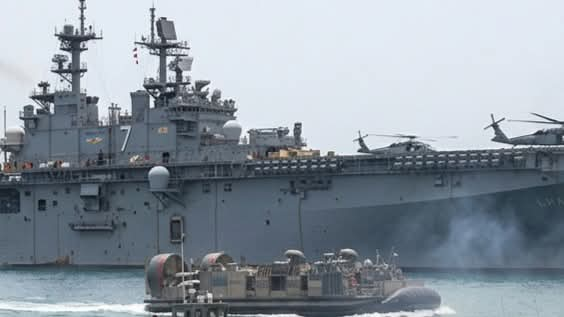
ashington/Middle East— The United States has deployed a major amphibious assault ship to the Middle East, bolstering its military presence amid the ongoing conflict with Iran and fueling discussions about potential ground troop involvement.
U.S. Central Command (CENTCOM) announced on Saturday that the USS Tripoli (LHA-7), an America-class amphibious assault ship normally based in Sasebo, Japan, arrived in the CENTCOM area of responsibility on Friday, March 27, 2026. The vessel serves as the flagship for the Tripoli Amphibious Ready Group and carries approximately 3,500 U.S. sailors and Marines from the 31st Marine Expeditionary Unit (MEU).
The Tripoli is equipped with advanced capabilities, including F-35B stealth fighters, MV-22 Osprey tiltrotor aircraft, heavy-lift helicopters, landing craft, and other amphibious warfare systems designed for rapid expeditionary missions, sea-to-shore operations, and contingency responses.
This deployment marks a significant addition to U.S. forces in the region as Operation Epic Fury enters its second month. It comes as the Pentagon and White House weigh options for further escalation, including reports of discussions around sending up to 10,000 additional troops— potentially including infantry and armored units — to provide President Donald Trump with greater operational flexibility.
Secretary of State Marco Rubio sought to temper speculation about a large-scale ground invasion during recent remarks. He stated that core U.S. objectives — destroying Iran’s missile and drone production facilities, crippling its navy and air force, and degrading its launch capabilities — are “ahead of schedule” and can be achieved without ground troops. Rubio emphasized the operation is expected to conclude in “weeks, not months,” while acknowledging that deployments prepare for possible contingencies.
The arrival of the Tripoli adds to other recent reinforcements, including elements of the 82nd Airborne Division and the impending deployment of the USS Boxer Amphibious Ready Group with the 11th MEU. Analysts view the move as a signal of heightened readiness rather than an immediate prelude to invasion, though it expands options if the conflict evolves.
As tensions persist in the Gulf, with ongoing strikes and regional ripple effects, the USS Tripoli stands as a visible demonstration of American power projection in a volatile theater. Further developments are expected in the coming days as the administration weighs its next steps.