
Sudan’s army-led government has put a number on its drone accusations against Ethiopia: 70 attacks, 187 one-way drones and hundreds of casualties since February. It says it will take the case to the UN Security Council and the African Union. Ethiopia has denied similar charges before, and the evidence has not been independently verified.
By HahuPrime News Desk | November 1, 2026
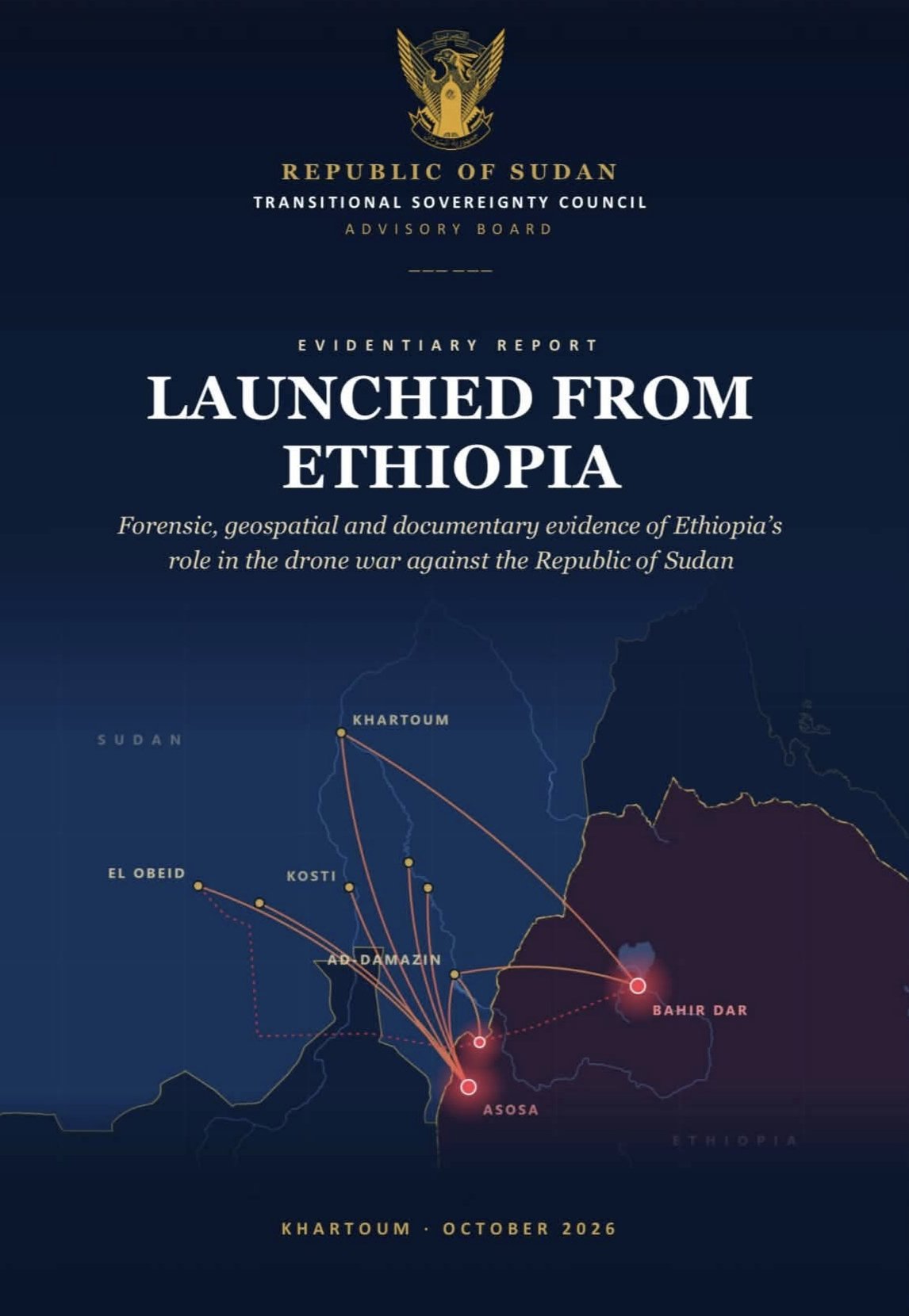
KHARTOUM — The drone came down near Ad-Damazin on September 20. What mattered to Sudanese investigators was not the wreck but a small black box inside it: the flight-control computer. According to a report released by Sudan’s Transitional Sovereignty Council, its memory held a programmed mission of 12 steps, and the first set of coordinates sat 1.7 kilometres inside Ethiopia, near the border town of Gizen.
The planned route ran 134.04 kilometres. Its take-off point, its first climb and roughly the first ten kilometres of the flight path were all on the Ethiopian side, the report says.
That autopilot is now the centrepiece of a document titled “Launched From Ethiopia”, which the council’s advisory board published over the weekend. On Sunday, Khartoum used it to make its most detailed case yet that drones striking Sudan are taking off from Ethiopian soil.
“Since February 2026, armed drones have taken off from Ethiopian soil … to strike Sudanese cities and civilians,” the report says, according to AFP.
What the report claims
The report lists 70 attacks between February 15 and October 27 that it attributes to Ethiopian launch areas. Together, it says, they involved 187 one-way attack drones and 82 munitions fired from larger strategic drones.
Sudan’s consolidated figures put the toll at 484 civilians killed or wounded, 176 soldiers killed and another 200 wounded. The pace, the report says, has picked up sharply. October alone accounts for 28 of the attacks and 97 of the one-way drones.
It names three launch areas: Asosa airport in western Ethiopia, the Kurmuk-Gizen stretch of the border, and the air base at Bahir Dar in the Amhara region. Debris attributed to Turkish-made Bayraktar Akinci drones operating from Bahir Dar is shown alongside factory plates with component serial numbers, according to the Sudan Independent, which published a detailed summary. Sudan is asking for those serial numbers to be checked against manufacturer and export records to see whether end-user commitments were broken.
The human cost is laid out incident by incident. On October 9, the report says, a strike on displaced families at Abu Shandi in Wad el-Mahi, in Blue Nile State, killed 30 civilians, 26 of them women and four of them children, and wounded 100. On October 19, three young children were killed in their home in Khartoum. Strikes on October 26 and 27 knocked six power stations out of service, leaving large parts of the country in the dark.
The document goes beyond the drones themselves. It cites a Reuters investigation from February that reported a camp at Menge, in Ethiopia’s Benishangul-Gumuz region, being used to train fighters from the paramilitary Rapid Support Forces (RSF). It also draws on Yale’s Humanitarian Research Lab, which reported activity at an Ethiopian military base in Asosa consistent with military support to the RSF. Yale said it could not independently confirm the Reuters account of the Menge camp.
The report ends with demands. It holds Ethiopia internationally responsible, calls for an immediate halt to launches, the closure of Ethiopian facilities to RSF and “third-party” operations, the dismantling of the Menge camp, and compensation. Sudan said it would file complaints with the UN Security Council and the African Union Peace and Security Council, while reserving its right to self-defence under international law.
A charge Ethiopia has rejected before
None of the evidence has been independently verified. HahuPrime could not find a response from Ethiopia’s Foreign Ministry to the new report by Sunday evening.
Addis Ababa has rejected earlier versions of the charge in strong terms. In May, after Sudan accused it of launching the drone that hit Khartoum International Airport from Bahir Dar, the Foreign Ministry called the allegations “baseless”. It said Ethiopia “has exercised restraint and refrained from publicizing the grave violations of its territorial integrity and national security committed by some belligerents in the Sudanese civil war”. It also accused Sudan’s army of arming and funding what it called “TPLF mercenaries” along Ethiopia’s western frontier, which Khartoum denies.
The United Arab Emirates, which Sudanese officials accuse of supplying the drones and funding the RSF, has also denied the claims. A UAE official told Al-Monitor in May that the accusation was a “fabrication” and “deliberate propaganda”.
Sunday’s report did not come out of nowhere. On Wednesday, at a joint press conference in Khartoum, officials displayed the wreckage of drones they said had been shot down and blamed launches from Bahir Dar for a week of strikes on power stations and fuel depots, as HahuPrime reported at the time. On Friday, Foreign Ministry undersecretary Muawiya Osman Khalid briefed foreign diplomats in Port Sudan. The state news agency SUNA said he described the attacks as an act of aggression against Sudan and part of a proxy war waged by Ethiopia on behalf of regional powers, foremost among them the UAE.
Why it matters for the region
The timing is dangerous. Ethiopia is fighting on several fronts at home, including renewed clashes in Tigray, where drone strikes have killed civilians in towns such as Rama. Its relations with Eritrea have collapsed, with embassies closed and diplomats expelled. Sudan, Eritrea, Egypt and Somalia have moved closer together, presenting a common front on the Red Sea and the Nile.
Both Sudan’s army and the RSF now depend heavily on drones that can strike targets hundreds of kilometres away without risking their own fighters. The UN says more than 1,100 people were killed in drone attacks across Sudan in the first half of this year alone. The strikes on power stations have hit ordinary Sudanese hardest, cutting electricity and water and, officials warn, making it harder for displaced families to return home. HahuPrime has followed the attacks on Sudan’s power grid since they began.
A complaint to the Security Council would move the dispute from press conferences into a formal diplomatic arena, where Ethiopia would be expected to answer. Whether the council acts is another matter. But Sudan has now put coordinates, serial numbers and casualty lists on paper, and those can be checked. That is what international investigators, and Ethiopia, will be asked to do next.
Sources
- AFP, via Arab News: “Sudan says drone attacks from Ethiopia killed, wounded hundreds” (November 1, 2026)
- Sudan Independent: summary of the Sovereignty Council advisory board report (November 1, 2026)
- Sudan News Agency (SUNA): briefing of diplomatic missions on drone attacks (October 30, 2026)
- Al-Monitor: “Ethiopia rejects Sudan’s strike claims, accuses Khartoum of backing Tigray rebels” (May 5, 2026)
- Reuters: “Ethiopia builds secret camp to train Sudan RSF fighters, sources say” (February 10, 2026)
- Yale Humanitarian Research Lab: special report on Asosa
- Addis Standard: “Ethiopia rejects ‘baseless’ Sudan drone strike accusations”