
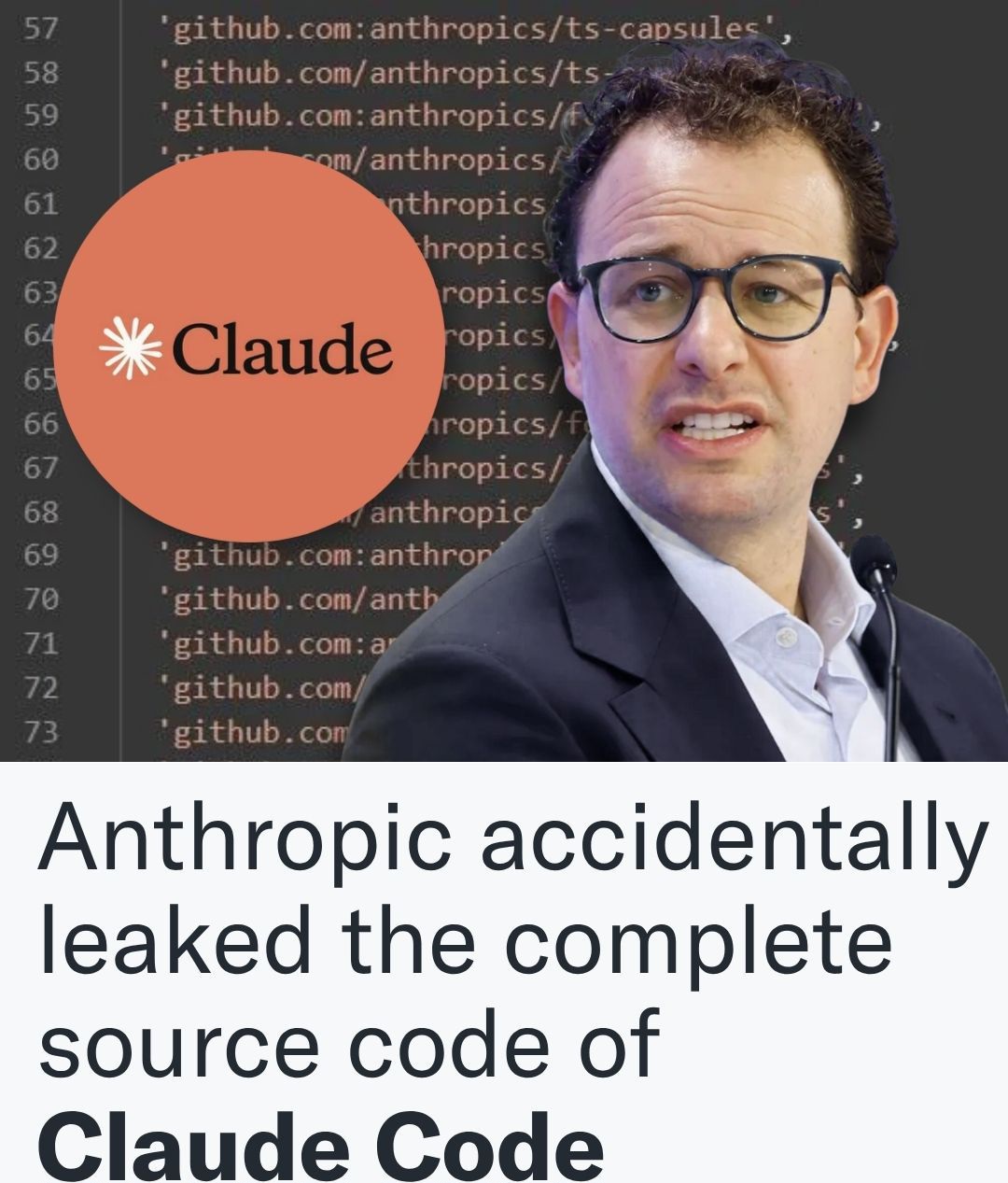
Anthropic Suffers Embarrassing Source Code Leak: Claude Code CLI Exposed via npm Blunder, Revealing Agentic Future and Unreleased Features
By AI Tech Staff
March 31, 2026 In a surprising turn of events that has sent ripples through the AI developer community, Anthropic—the company behind the popular Claude family of AI models—has inadvertently leaked the entire source code of its Claude Code command-line interface (CLI) tool. The exposure, discovered on March 31, 2026, stems from a basic packaging error in the npm registry and marks the second such incident for the company in roughly a year. Security researcher Chaofan Shou first flagged the issue on X (formerly Twitter), noting that version 2.1.88 of the @anthropic-ai/claude-code npm package included a massive 59.8 MB source map file named cli.js.map. This debugging artifact, typically excluded from production builds, contained embedded references allowing reconstruction of the full original TypeScript codebase—approximately 1,900–1,906 files totaling over 512,000 lines of code. Within hours, the complete source was mirrored on public GitHub repositories, drawing thousands of stars and forks before Anthropic reportedly began issuing DMCA takedown notices. The leak did not involve model weights, training data, or backend infrastructure, but rather the client-side tooling layer that orchestrates interactions with Claude models, manages tools, permissions, memory, and agentic behaviors.
A Glimpse into Anthropic’s Agentic Ambitions
Analyses of the exposed code paint a picture of Claude Code evolving far beyond a simple coding assistant into a persistent, autonomous “AI employee” capable of running 24/7 in the background. Key unreleased or hidden features highlighted in community dissections include: – Proactive / KAIROS Mode: Feature flags and code paths for an always-on assistant that monitors workflows, logs activity, and takes initiative without constant user prompts. It includes mechanisms like a 15-second action budget to balance autonomy with usability, positioning Claude as a proactive collaborator rather than a reactive tool. – Dream / Auto-Dream Mode: A background “memory consolidation” system that runs as a forked sub-agent. Triggered by time elapsed and session activity, it processes conversation history through stages like orient → gather → consolidate → prune. Prompts explicitly reference “You are performing a dream,” aiming to refine long-term knowledge and generate ideas while the user is away. – Intelligent Auto-Approval and Permission Systems: Enhanced logic for deciding when to auto-approve tool use (such as file edits or shell commands), moving beyond simplistic always-approve behaviors toward more thoughtful, ML-informed decisions. – Undercover Mode: References to stealth operation, including warnings in system prompts for contributing to open-source repositories without revealing Anthropic affiliation. Commit messages and actions must avoid leaking internal information to “not blow your cover.” – x402 Agentic Payments: Support for crypto-based protocols that could enable autonomous agents to handle payments independently. – Upcoming Model References: Code mentions Opus 4.7, Sonnet 4.8, and internal codenames like Capybara (a higher-tier model family described elsewhere as larger and more capable than current Opus models) and Mythos. These align with a separate recent data cache leak that previewed Anthropic’s plans for significantly more powerful models, including one flagged for “unprecedented cybersecurity risks.” The codebase also exposes internal prompts, telemetry systems (including logging of user frustration or profanity in inputs), safety mechanisms, and orchestration logic for sub-agents, hooks, and persistent sessions.
Community members have described the code as complex and sometimes messy, with notes on high false-positive rates in certain prompts. While some developers are excited about the “free blueprint” for building advanced agents, others have criticized the quality and raised questions about Anthropic’s engineering discipline.
A Classic Packaging Oversight
The root cause appears straightforward: the Bun runtime used to build Claude Code generates source maps by default, and the project’s .npmignore file (or equivalent configuration) failed to exclude *.map files from the published package. As a result, the source map pointed to original sources hosted in Anthropic’s own R2 cloud storage bucket, making the full codebase easily downloadable. This is not Anthropic’s first npm-related slip-up. A similar source map exposure occurred in early 2025 with an earlier version of the tool. Critics, including AI safety observers, have pointed out the irony—Anthropic markets itself heavily on responsible AI development and safety, yet basic DevOps hygiene continues to falter.
Immediate Reactions and Implications
The leak has sparked intense discussion across developer forums, Reddit, Hacker News, and X. Many are treating the exposed code as educational material, with some creating clean-room reimplementations or extracting prompts and architectures for their own agent projects. Others warn of potential security risks, as the code details exactly how permissions, tool calling, and memory work—information that could aid both legitimate builders and malicious actors. Anthropic has not issued an official public statement at the time of writing, though the company is actively working to remove mirrors. Users of Claude Code are advised to: – Update to the latest version (if a fixed package has been released) – Use Anthropic’s native installers where possible instead of npm – Audit any local API keys or sensitive data in their environments – Monitor for any anomalous behavior For the broader AI industry, the incident underscores ongoing challenges with supply-chain security in the fast-moving ecosystem of AI tooling. As companies race to ship agentic products—persistent, multi-step, autonomous systems—the pressure to iterate quickly can sometimes lead to oversights.
Looking Ahead: Toward 24/7 AI Colleagues?
Despite the embarrassment, the leak offers a rare window into Anthropic’s roadmap. The emphasis on proactive modes, background dreaming, persistent memory, and sub-agent orchestration suggests Claude Code is being positioned as infrastructure for true AI teammates that can work asynchronously, consolidate knowledge overnight, and act with increasing independence. This aligns with industry-wide trends: OpenAI, Google, and others are also investing heavily in agent frameworks. If Anthropic successfully rolls out features like KAIROS and Dream modes alongside more powerful models (Capybara/Mythos tier), it could accelerate the shift from chat-based AI to always-available digital workers. In the meantime, the developer community is already hard at work experimenting with the leaked insights. Some repos are emerging with rewritten components in Rust or Python, while others focus on enhancing safety layers inspired by (or despite) what was exposed. As one X user put it: “This isn’t just a leak—it’s an accidental open-sourcing of Anthropic’s vision for the agentic future.” Stay tuned to AI Tech Desk for updates as Anthropic responds and the full implications of the Claude Code leak become clearer.
This article is based on public reports, community analyses, and technical dissections available as of March 31, 2026.