
Addressing parliament on Thursday, Prime Minister Abiy Ahmed said peaceful coexistence was possible if Eritrea ended what he called support for Ethiopia’s adversaries. He insisted Ethiopia would seek Red Sea access through dialogue, but said his country would prevail if war broke out. The same day, Eritrea’s information minister told United Nations officials that Ethiopia was preparing a “massive war of aggression.”
By HahuPrime News Desk | November 27, 2026
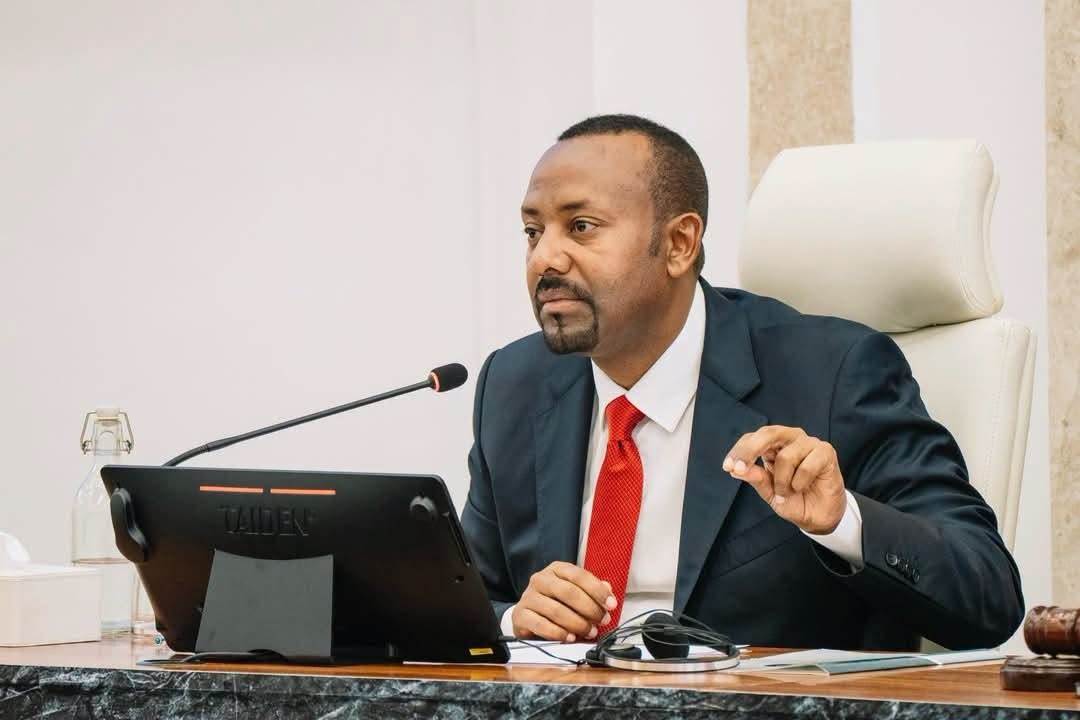
ADDIS ABABA — Prime Minister Abiy Ahmed told the House of Peoples’ Representatives on Thursday that Eritrea must stop arming and collaborating with forces hostile to Ethiopia, warning that “destruction will fall upon Eritrea” if its ruling front did not change course.
He also said Ethiopia would not invade Eritrea to reach the Red Sea. “We will not wage an invasion. Invasion is not needed; we want it peacefully and through dialogue,” Abiy said, according to Addis Standard.
The remarks came at the fourth regular session of the first working year of the seventh parliament, as the two neighbours remain in a sharp dispute over sea access, mutual accusations of backing armed groups, and a military build-up along their border. Diplomatic ties were cut in early October after fighting resumed in Tigray in September.
Two demands, and a warning
Abiy was answering a lawmaker who accused the Eritrean government of a longstanding hostile policy toward Ethiopia and asked how long Addis Ababa would tolerate it, BBC Amharic and Addis Standard reported.
“What do we want from the Eritrean government? Two things. First, stop arming Ethiopia’s enemies, being a supply line, and cooperating with Ethiopia’s enemies. Second, let us work together for shared development in every sphere,” he said, according to Addis Standard. The state-run Ethiopian News Agency (ENA) reported the same two demands, including that Eritrea stop “serving as a weapons supply conduit.”
Ethiopia, Abiy said, would contribute “the ideas, the money, and the labor.” ENA quoted him as saying: “If you can do this (pursue cooperation), living together in peace is possible.” He added, in ENA’s English rendering: “Destruction will fall upon Eritrea, if Shaebia remains a force mired in incorrigible mistakes.”
Shaebia, or Shabia, is a commonly used Ethiopian term for Eritrea’s ruling front, which grew out of the Eritrean People’s Liberation Front. BBC Amharic carried the warning in the original Amharic as: if Shaebia “remains a force mired in an uncorrectable mistake, the destruction will fall upon Eritrea.”
Abiy said Ethiopia had offered to supply Eritrea with electricity at Ethiopian domestic rates and to develop roads and ports together, and that Asmara had refused. “Words like development and growth do not exist in its vocabulary,” ENA quoted him as saying. Those are his characterisations; Eritrea has not, in the official texts it published on Thursday, addressed those specific offers.
The accusation that Eritrea is arming groups inside Ethiopia has been made repeatedly by federal officials this year. It has not been independently verified, and Asmara has consistently rejected it.
No invasion, but a warning of victory in war
Abiy returned to landlocked Ethiopia’s campaign for Red Sea access, now in its third year as an official talking point. He rejected what he said were claims that Ethiopia planned to invade Eritrea for a coastline.
He pointed to Jordan, Iraq and Poland as countries that, he said, had obtained sea access through agreements rather than war, a comparison reported by BBC Amharic, BBC Somali and BBC Afaan Oromoo. “This is what should be put into practice; war is not needed,” he said, according to BBC Amharic.
He also said Ethiopia could not be shut off “on land and in the sky” if the region were to be at peace, and argued that Ethiopian instability would spill over to its neighbours. “Because we are a large tree, if we stand firm our shade reaches the neighborhood, yet if our trunk is harmed, everyone is harmed,” Addis Standard quoted him as saying.
At the same time, he struck a harder note. If fighting began, “there is no doubt Ethiopia will win,” he said, according to BBC Amharic. “It is not just one force that might say ‘I will join in’; even then we are the victors, and that is what we are preparing for.” BBC Afaan Oromoo and BBC Somali reported the same warning, including his remark that he did not think others would come to Eritrea’s aid. Lawmakers applauded, BBC Amharic said.
Abiy credited Eritrea for its early stance when Ethiopia’s Northern Command was attacked at the start of the Tigray war in November 2020, but he accused Eritrean forces of later killing young people, destroying infrastructure and looting in Tigray. He said relations soured after the November 2022 Pretoria Agreement, to which Eritrea was not a party. Those accusations are his; rights organisations documented serious abuses in Tigray during the 2020–22 war, including by Eritrean troops, but HahuPrime has not independently verified the specific incidents he described on Thursday.
He also repeated the federal government’s claim that Tigray People’s Liberation Front (TPLF) leaders who resumed fighting in September had entered Eritrea, and that more than 800 vehicles had been taken there, BBC Amharic reported. Eritrea and TPLF leaders have previously denied to AFP that Tigrayan forces crossed into Eritrea.
What Asmara published the same day
HahuPrime found no formal, direct Eritrean government reply to the Thursday speech itself by Friday evening. Two official texts published the same day on the information ministry’s site, Shabait, set out Asmara’s position.
In remarks to a retreat of UN resident representatives and regional directors at Asmara Palace, Information Minister Yemane Gebremeskel said: “That Ethiopia is set to launch a massive war of aggression against Eritrea is not a matter for debate or speculation.” The text, posted on Thursday, said the retreat was held “this week.”
Yemane said Ethiopia had decided to go to war to obtain what it calls “sovereign access to the sea” and to establish a Red Sea naval force with “strategic depth,” which he said would mean, “in their own words,” incorporating Eritrea’s entire southern coastline up to the Dahlak islands. He said Ethiopia had notified the UN Security Council on October 9 that it was taking measures against Eritrea, “by portraying itself as the invaded and aggrieved party.” He also attributed to Ethiopia’s deputy chief of staff, General Abebaw Tadesse, a September 27 remark that an offensive in Tigray aimed to occupy the port of Assab and “install the Ethiopian flag in the Red Sea.” HahuPrime has not independently confirmed that quotation.
Yemane said Ethiopia could negotiate commercial access on preferential terms with Sudan, Eritrea, Djibouti, Somalia and Kenya, and that Red Sea security “falls within the purview of the Littoral States.” The cost of a war, he said, would be “exponentially higher” than the $1.5 billion a year Ethiopia says it spends on port fees. “The only solution that one can contemplate is application of meaningful pressure on Ethiopia to abandon these reckless policies,” he said.
A separate commentary issued on November 26 by the Ministry of Foreign Affairs’ Research and Documentation Division, which did not mention Abiy’s speech, accused the ruling Prosperity Party of using “maritime diplomacy” to “camouflage its irredentist ambitions.” It said Eritrea “has never opposed mutually beneficial commercial utilization of its ports, provided such arrangements are founded on respect for Eritrean sovereignty,” but “will not surrender an inch of its territory or maritime domain to diplomatic theatre, economic coercion, or the threat or use of force.”
Fighting closer to the border
The exchange comes as combat in Tigray has moved toward the Eritrean frontier. Residents told BBC Amharic that fighting took place on Wednesday and Thursday between the Ethiopian National Defense Force and Tigrayan forces in Gemahalo and Nafra, close to Badme. The Armed Conflict Location and Event Data project (ACLED) said Ethiopian forces and their ally, the Tigray Peace Force, had taken full control of Gual Gemahalo on Thursday and were moving further toward the border, BBC Amharic reported.
There was no clear evidence in those accounts that Eritrean and Ethiopian troops had clashed in the latest fighting, BBC Amharic said. Neither government has confirmed this week’s combat, and Abiy did not address it in his remarks to parliament, DW Amharic noted, according to Mereja.
Last week, Reuters, ACLED and the International Crisis Group described a dangerous build-up of Ethiopian and Eritrean forces around Badme, a flashpoint of the 1998–2000 border war, as HahuPrime reported on 18 November. Reuters said it could not independently confirm reported skirmishes between the two national armies.
The African Union and G7 foreign ministers have called on both sides to exercise maximum restraint. The accusations from Addis Ababa and Asmara remain, on the central claims of arming proxies and preparing an invasion, unverified by independent observers.
Sources
- Ethiopian News Agency (ENA), “PM Abiy Urges Eritrea to Stop Arming Ethiopia’s Adversaries, Calls for Joint Development,” November 26, 2026
- Addis Standard, “‘Stop arming Ethiopia’s enemies’: Abiy tells Eritrea, says Addis Abeba seeks Red Sea access through dialogue,” as republished by allAfrica, November 26, 2026
- BBC Amharic, “If Shaebia remains mired in an uncorrectable mistake, the destruction will fall upon Eritrea — Prime Minister Abiy,” November 26, 2026
- BBC Amharic, “Residents say fighting has been underway since Wednesday in border areas near Badme,” November 27, 2026
- BBC Somali, “Abiy Ahmed sends a message mixing peace and warning to Somalia, Eritrea and the region,” November 26, 2026
- BBC Afaan Oromoo, “We want peace with Eritrea, but we will win even if others join them — Abiy Ahmed,” November 26, 2026
- Eritrea Ministry of Information (Shabait), “Remarks by Minister Yemane G/meskel at the 2026 UN Country Team Retreat,” November 26, 2026
- Ministry of Foreign Affairs of the State of Eritrea, Research and Documentation Division, “Ethiopia’s Calculated Use of Maritime Diplomacy to Camouflage its Irredentist Ambitions in the Region,” November 26, 2026
- ChimpReports, “Abiy Warns Eritrea Against Arming Ethiopia’s Enemies,” November 26, 2026
- Ethiopia Observer, “Abiy warns Eritrea of consequences if it fails to change course,” November 27, 2026
- Mereja, “Abiy on Eritrea: no Red Sea invasion, but ‘the damage will fall on Eritrea’,” citing BBC Amharic and DW Amharic, November 26–27, 2026
Corrections: info@hahuprime.com.