
Google says a prototype satellite carrying its own AI chips has run a language model in orbit and sent the answer back to Earth. The first output was a three-line poem. The real test, whether the chips can survive radiation and heat in space, is only now beginning.
By HahuPrime News Desk | October 31, 2026
MOUNTAIN VIEW, California — The message came down over Svalbard, the Arctic archipelago north of Norway, during one of the brief windows when the satellite passed within reach of a ground station. Engineers had asked the machine a simple question: write a haiku about being in space.
The answer read: “Blue marble below / Data streams in silent grace / Starlight feeds my core.”
It is not great poetry, but Google says it is a first. The lines were produced by Gemma 4, one of the company’s open AI models, running on a data-centre-class Tensor Processing Unit, or TPU, aboard a prototype satellite for Project Suncatcher, Google’s long-shot effort to find out whether the computing power behind artificial intelligence could one day be moved off the planet.
“This week, we reached our ‘Hello World’ milestone: the first-ever AI response from a data center class TPU in orbit,” Travis Beals, senior director of Paradigms of Intelligence at Google, wrote in a company blog post on Friday.
Chief executive Sundar Pichai shared the news on X. “After launching our prototype satellite a few weeks ago, we’ve now successfully sent a command up to orbit, booted up the TPU, ran the prompt, and received our first complete response back on earth – a haiku!” he wrote.
Four chips, one at a time
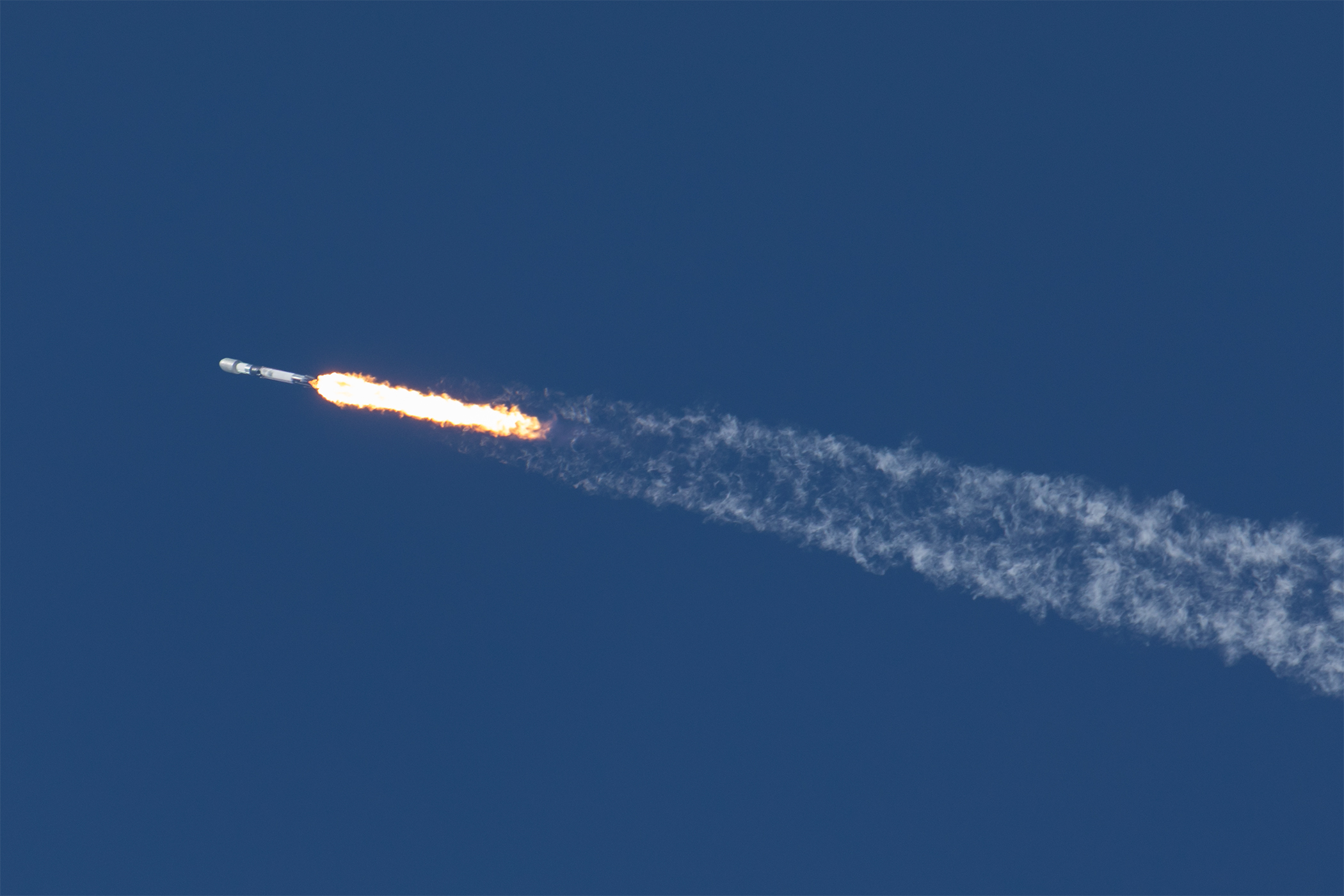
The satellite was built with Planet Labs, the Earth-imaging company, and launched on October 1 aboard SpaceX’s Transporter-18 rideshare mission from Vandenberg Space Force Base in California.
Google then spent about three weeks commissioning it, powering up the host computer and TPU trays and running early machine-learning tests.
The hardware is modest by data-centre standards. TechCrunch reported that the spacecraft carries four TPUs and generates up to 1 kilowatt of electricity. That power budget means only one chip can run at a time, and only for about 20 minutes.
After the haiku, the team sent space-themed limericks and, more usefully, prompts asking the system to report on the technical status of its own payload. A Google spokesperson told TechCrunch the satellite was “operating nominally.”
Why put AI chips in orbit at all
The idea behind Suncatcher is energy. AI runs in huge data centres that draw enormous amounts of electricity, and the companies building them are hitting limits on power, land and local patience.
When Google first announced the project in November 2025, it argued that in the right orbit a solar panel can be up to eight times more productive than on Earth and can generate power almost continuously. The plan it described then was a cluster of satellites flying in a dawn-to-dusk sun-synchronous orbit, bathed in near-constant sunlight and linked to one another by laser beams.
The formation would be extremely tight. One design in Google’s research placed 81 satellites within a kilometre of each other, neighbours just 100 to 200 metres apart, so the laser links could carry the huge data flows AI needs.
Cost is the other big question. Google’s 2025 analysis suggested launch prices could fall below $200 per kilogram by the mid-2030s if they keep dropping. At that level, it said, launching and running a space data centre could become roughly comparable to the energy costs of an equivalent one on the ground.
That forecast leans heavily on SpaceX. TechCrunch noted that both Google’s and SpaceX’s plans for orbital computing depend on Starship, the giant rocket still in development, becoming fully and rapidly reusable. A peer-reviewed analysis by Suncatcher researchers published this month estimated that Starship would need around 1,800 flights to achieve the kind of cost reductions SpaceX saw with its earlier rockets.
The hard part comes next
Running one prompt proves the system works. It does not prove it lasts.
“Next, we will continue with a series of tests to evaluate how TPUs perform under thermal stress and radiation exposure in orbit,” Beals wrote. With no air to carry heat away, chips must shed it through radiators, and charged particles can flip bits in memory, silently corrupting data.
Google has already tested its chips on the ground. In 2025 it fired a proton beam at Trillium, its sixth-generation Cloud TPU; the memory showed irregularities only after about three times the dose expected over a shielded five-year mission. Ground tests suggested radiation would matter less for running models than for training them, TechCrunch reported. Now the team will find out whether that holds up in orbit.
If it does, the next step is a pair of more powerful satellites in 2027, designed to show that two spacecraft can share work over an optical link. Startups such as Starcloud are also chasing orbital computing, but TechCrunch said Google’s plan stands out for aiming to tie satellites together closely enough to share work.
A moonshot in a nervous market
The timing is awkward. The haiku arrived in a week when investors grew openly worried about how much Big Tech is spending on AI infrastructure. Reuters reported that Alphabet suffered its biggest one-day percentage drop on record on Thursday after disappointing search advertising results and a sharp jump in cash burn, and that the Nasdaq 100 was on course to lose more than $2 trillion in market value in October.
Suncatcher will not ease those worries soon. Google calls it a moonshot, in the same family as its early bets on quantum computing and self-driving cars, and says the aim is infrastructure that could make economic sense in the 2030s.
For now, the achievement is small and specific: a chip built for server racks woke up in orbit, did what it was told, and wrote a few lines about the view. “Our chips have officially earned their space wings,” Beals wrote, “an important achievement on the long road ahead for this cosmic moonshot.”
Google’s push to stay ahead in AI has been visible on the ground too, from its restricted Gemini 4 Carbon model for cyber defenders to the wider race for capital highlighted by Anthropic’s record IPO filing. SpaceX, which launched the satellite, has also been at the centre of debates over the power of private space companies, as seen in Elon Musk’s shifting stance on Starlink and Ukraine.
Sources
- Google (The Keyword): We’ve received our first response from the Project Suncatcher prototype satellite
- Google (The Keyword): Our Project Suncatcher prototype satellite is in orbit
- Google Research: Exploring a space-based, scalable AI infrastructure system design
- TechCrunch: Google’s first data center satellite is online and writing poetry
- The Verge: Google’s satellite AI server transmits its first response to Earth
- NDTV: Google Project Suncatcher gets AI response from space
- Planet Labs (Business Wire): Planet Launches Suncatcher, Tanager-2, and 18 SuperDove Satellites
- Reuters: Nasdaq faces $2 trillion wipeout in October as AI spending fears deepen