
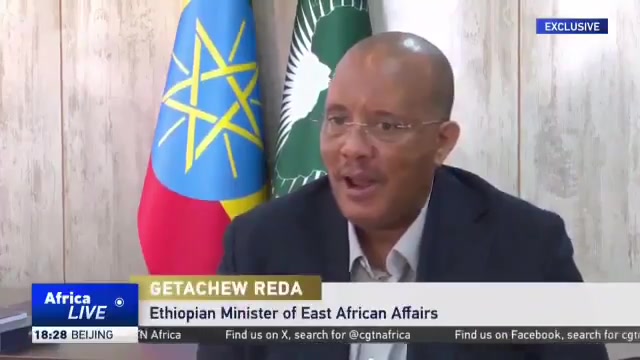
In an exclusive interview with CGTN Africa, Getachew Reda accused Eritrea’s president of engineering the war in northern Ethiopia and warned of “very dire” consequences if Asmara keeps fighting. He also said Tigray will stay under federal control for six months before elections.
By HahuPrime News Desk | October 17, 2026
ADDIS ABABA — Asked by CGTN correspondent Girum Chala about Ethiopian forces near the Eritrean border, Getachew Reda opened his first answer by naming the man he blames for the fighting in northern Ethiopia.
“This war was engineered by President Isaias,” he said. “And for Eritrea, this was their survival mechanism.”
Getachew is Ethiopia’s minister for East African affairs and adviser to Prime Minister Abiy Ahmed, a post with ministerial rank. He spoke in an exclusive interview aired on CGTN Africa’s Africa Live programme around October 16. Over roughly four and a half minutes, he accused Eritrea, Egypt and Sudan’s military leadership of backing armed groups inside Ethiopia. He also set out the federal government’s plan for Tigray. Those accusations are his. HahuPrime has not been able to verify them independently.
- Getachew Reda told CGTN Africa that Eritrean President Isaias Afwerki “engineered” the war and warned of “very dire” consequences if he keeps “shooting”.
- He said Ethiopia is “not interested in imposing its will on Eritrea” and that talking is “the only game in town”.
- He accused Egypt and Sudan’s General Abdel Fattah al-Burhan of backing armed groups, claims both have previously rejected.
- He said Tigray will be under federal control for six months, followed by elections.
Getachew Reda’s warning to Asmara
Getachew argued that Eritrea, which he said lacks strategic depth, wanted the fighting kept as far from its own border as possible. “But they miscalculated big time,” he said. In his account, Asmara’s role handed the international community evidence of direct involvement in trying to stop the advance of Ethiopia’s national defence forces.
He insisted that Addis Ababa does not want a wider war. He said “the Ethiopian government is not interested in imposing its will on Eritrea.” Asmara should instead withdraw what he called its support for “subversive elements” in Ethiopia.
“The Eritrean president should understand that talking, not shooting, is the only game in town. Because shooting obviously hasn’t worked.” — Getachew Reda, CGTN Africa
The warning followed immediately. “And if he continues to entertain the idea that he can get away with shooting, the consequences will be very dire,” he said. He did not say what those consequences would be.
Eritrea tells a very different story. As HahuPrime reported, Foreign Minister Osman Saleh has asked the UN Security Council for Chapter VII measures against Ethiopia. He accuses Addis Ababa of pursuing Red Sea access by force and denies that Eritrean troops have entered Tigray. Information Minister Yemane Gebremeskel has called Getachew’s earlier accusations groundless, according to Natna News.
Egypt, Sudan and the wider alignment
Asked about the alignment of neighbours that Addis Ababa accuses of arming rebels, Getachew turned to Cairo. He said “whatever shenanigans they have is not going to create a dent in Ethiopia’s security and stability.” Working with Ethiopia, he argued, was Egypt’s best option.
He then addressed Sudan’s army chief. “And we expect General Burhan to also understand that no amount of suicide drones he would supply those elements in Ethiopia is going to serve any purpose for the people of Sudan,” he said. He described what he called a rogues’ gallery of anti-Ethiopian actors, including Eritrea, elements around Burhan and Egypt. “Those days are gone and gone forever,” he said.
Khartoum has made accusations of its own. At a recent Security Council briefing, Ethiopia rejected Sudan’s claims as “baseless” and raised drone attacks by an unnamed neighbour. CGTN reported on October 7 that Eritrea, Sudan and Egypt had all rejected Ethiopian allegations of support for anti-government forces. They argued that Addis Ababa was using them to deflect from domestic problems. HahuPrime found no response from Asmara, Cairo or Khartoum to this interview by Saturday morning.
What comes next for Tigray
The last question was about civilian rule in Tigray, where federal and allied forces retook Mekelle this month. “For the next six months, Tigray will be under federal control,” Getachew said. “But it will have an administration that will take care of day-to-day activities, economic, security, rehabilitation, and all that.”
“Once that happens, of course, there will be elections in six months’ time, and whoever wins this election will take over the mantle of power, and then of course Tigray will become a normal member of the Ethiopian federation once again,” he said.
That plan matches the federal government’s announcement of a six-month caretaker administration for Tigray, which has five appointed officials and a mandate to restore services, coordinate security and prepare for elections. No election date has been set. The TPLF-led Tigray authorities have rejected that administration as illegitimate. In a statement signed “Government of Tigray”, they said its decisions have no legal force.
The state broadcaster EBC also reported the interview, focusing on Getachew’s call for Cairo to drop what it called proxy tactics. For people in Mekelle and Adigrat, the more immediate question is the six-month clock. It began with the caretaker administration’s announcement on October 16, which puts the promised vote around mid-April 2027.
Sources
- CGTN Africa, Africa Live: exclusive interview with Getachew Reda by Girum Chala, aired around October 16, 2026 (watch the clip)
- EBC: Getachew Reda Urges Cairo to Drop Proxy Tactics, Embrace Direct Engagement
- CGTN: Ethiopia-Eritrea tensions raise fears of wider Horn of Africa conflict
- Natna News: Getachew Reda urges the EU to impose targeted sanctions on Eritrea