
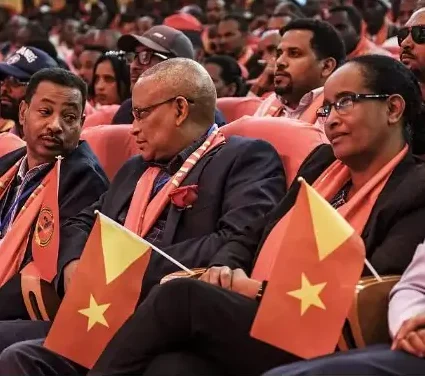
WASHINGTON, D.C. — June 18, 2026 — In a calibrated diplomatic intervention aimed at preventing a catastrophic collapse of peace in the Horn of Africa, the United States government has announced targeted visa restrictions against hardline members of the Tigray People’s Liberation Front (TPLF) and their immediate family members.
The punitive measures, enacted under foreign policy-based statutory authorities, signal deep-seated alarm in Washington over a dangerous combination of recent military escalations, forced conscription, and political brinkmanship that threaten to dismantle the fragile truce established nearly four years ago.
The policy shift was formally announced in a press statement by U.S. Department of State Spokesperson Thomas “Tommy” Pigott. Operating under the authority of Secretary of State Marco Rubio, the State Department invoked Section 212(a)(3)(C) of the Immigration and Nationality Act (INA) to restrict U.S. entry for individuals deemed responsible for, or complicit in, obstructing a peaceful resolution to the crisis in the Tigray region.
“The United States will continue to stand with the Ethiopian people, including the people of Tigray, who want to live in peace and dignity,” Spokesperson Pigott stated, adding a stern warning to regional actors: “We will continue to use all tools available to expose and promote accountability for TPLF officials and other individuals who threaten that peace and stability in the region.”
By extending the restrictions to immediate family members, U.S. policymakers are utilizing a targeted leverage mechanism frequently deployed against foreign elites to disrupt international travel, asset management, and educational placements in Western nations. While the policy framework is now active, the specific names of the sanctioned individuals remain confidential under U.S. visa record privacy laws.
The urgency underlying Washington’s intervention is deeply rooted in a humanitarian crisis that has now entered its sixth consecutive year. For hundreds of thousands of civilians displaced during the height of the 2020–2022 civil war, the suffering has never stopped. Tens of thousands of Tigrayan refugees who fled into neighboring Sudan in late 2020 remain stranded in neglected camps, while hundreds of thousands of Internally Displaced Persons (IDPs) from Western Tigray continue to languish in makeshift shelters across the region, unable to return to their homes.
Now, a new demographic panic is unfolding. Haunted by the memories of a war that claimed an estimated 600,000 lives, thousands of Tigrayan youths are actively fleeing the region and the country. This mass exodus is driven not only by the fear of renewed hostilities but also by aggressive forced recruitment campaigns. Credible reports indicate that hardline elements aligned with the TPLF have been conducting sweeps to conscript young men and women into Tigray forces against their will — actions that directly contradict the demilitarization commitments of the 2022 Pretoria Cessation of Hostilities Agreement (CoHA).
The threat to the peace agreement is a deeply complex, multi-sided crisis. A primary driver of the current tensions is the internal power struggle within Tigray itself. In 2025, a hardline TPLF faction removed Getachew Reda, the previous interim president and former TPLF Executive Committee member. They initially backed Lt. Gen. Tadesse Werede as a compromise president of the Tigray Interim Regional Administration, whose term was formally extended by the federal government in April 2026. However, just weeks later, the same hardline faction moved to sideline him, bypassing the interim structure entirely and reinstating the party’s pre-war regional council under its direct control.
This internal shift has heightened anxieties over the unresolved status of Western Tigray (Welkait-Tegede) and Southern Tigray (Raya). These territories were administratively part of Tigray prior to the 2020 war. The Pretoria agreement called for the restoration of Tigray’s pre-war boundaries through constitutional processes, with any additional arrangements to follow only after that constitutional step. Addis Ababa’s prolonged delays in addressing these territorial issues and facilitating the safe return of displaced Tigrayans have provided the hardline faction with a potent narrative for remilitarization. At the same time, Western diplomats view the subsequent forced recruitment drives as an explicit and dangerous breach of the 2022 Pretoria demilitarization clauses.
Compounding the volatility are reports of shifting alignments. Intelligence and diplomatic sources have raised concerns over “Tsimdo” — reported backchannel contacts between certain hardline Tigrayan commanders and elements of the Eritrean regime. For Washington, the prospect of rogue regional actors forming cross-border understandings represents a serious risk to regional stability.
In recent weeks, the hardline TPLF leadership has explicitly moved to reinstate pre-war regional government structures, a step widely viewed as effectively nullifying key elements of the Pretoria agreement. This development coincided with reported federal drone strikes near Sheraro in northwestern Tigray in early June, which Tigray sources accused of targeting their forces. At the same time, armed clashes have continued between the main Tigray Defense Forces and the dissident Tigray Peace Force (TPF), an armed faction operating from the Afar region and led by Brigadier General Gebreegzabher Beyene (Wedi Antru). These intra-Tigrayan confrontations have added another layer of fragmentation and instability along Tigray’s southeastern border.
The U.S. visa restrictions represent a diplomatic effort to pressure the political and military actors most responsible for undermining the peace process before localized tensions spiral into wider conflict. However, with hundreds of thousands still displaced, ongoing forced recruitment, and deep uncertainty over Tigray’s internal governance, the path to implementing the Pretoria Agreement remains highly precarious.