
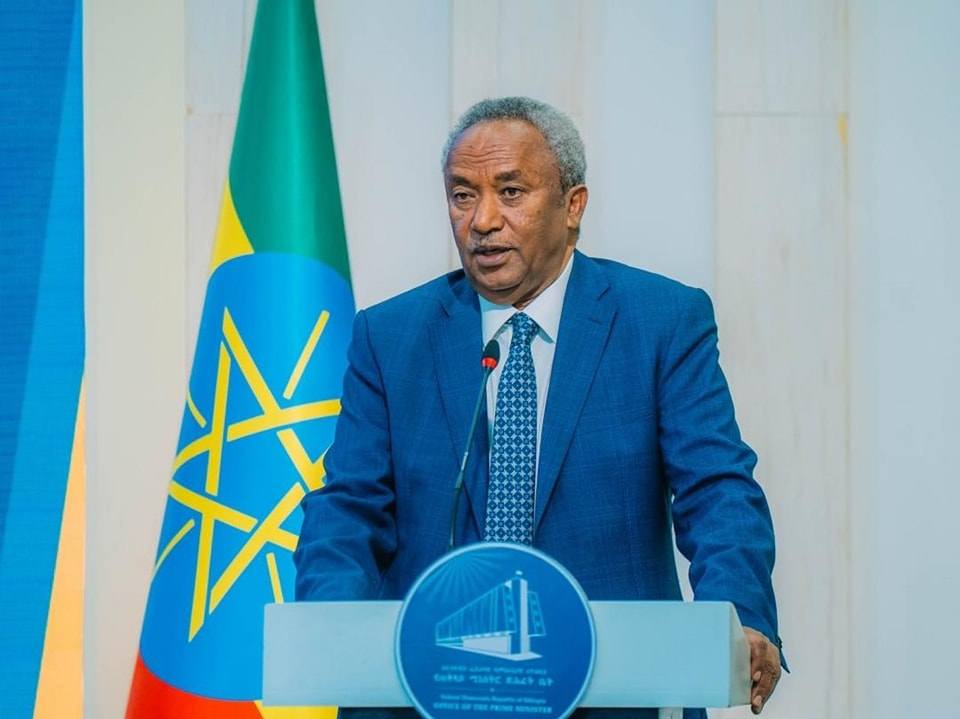
Lt. General Tadesse Werede, the wartime commander of the Tigray Forces, has taken over leadership of the Tigray Interim Administration (TIRA), replacing Getachew K Reda, who served for two years before being ousted by internal rivals.
𝐇𝐞𝐫𝐞 𝐢𝐬 𝐰𝐡𝐚𝐭 𝐢𝐭 𝐦𝐞𝐚𝐧𝐬.
Tadesse’s transition from being a battlefield commander to political leadership marks a notable development. He has never held formal political office, nor is he deeply entangled in the TPLF’s party-centric politics—an attribute that may enhance his public image in Tigray. His seemingly non-partisan public persona is seen by some as an advantage, positioning him as a stabilizing figure amid internal fractures.
In the short term, his leadership is expected to reduce tensions. He has publicly committed to refraining from activities that undermine Ethiopia’s constitution, sovereignty, or the Pretoria Agreement—remarks broadly interpreted as a signal of disengagement from any informal ties with Eritrea. This is indeed a de-escalatory approach on his side, even though the Ethiopia-Eritrea dynamic remains inherently unstable.
𝑇𝑎𝑑𝑒𝑠𝑠𝑒 𝑚𝑎𝑑𝑒 ℎ𝑖𝑠 𝑤𝑎𝑦 𝑖𝑛𝑡𝑜 𝑡ℎ𝑒 𝑝𝑟𝑒𝑠𝑖𝑑𝑒𝑛𝑐𝑦
While Tadesse maintained a reserved and enigmatic public profile, behind the scenes he quietly navigated and (might have been engineering) the shifting power dynamics. He oversaw the slow decline of the Tigray Interim Regional Administration (TIRA) – a structure he was also part of, and did little to prevent Tigray security actors and commanders under his influence from openly undermining Getachew. Though he did not publicly declare a political stance, his neutrality was not neutral – it was an active political maneuvering.
His media appearances have always been carefully crafted—delivering both good and bad news without revealing much of his own positioning. This is a mastered ambiguity that enabled him to steadily build political capital.
Tadesse’s path to the presidency was strategic. Initially proposed by the Debretsion Gebremichael ‘s TPLF faction, he subsequently engaged directly with federal political and military actors, leveraging the growing regional influence of the Tigray security forces. Ironically, that same military leverage could become a vulnerability if not managed carefully. The Tigray security actors have become the power brokers in the region, slowly unmaking the traditional civilian domination in Tjgray.
The commitments he signed upon assuming office—particularly his pledge to “constitutional and sovereignty principles”—appear to reflect Addis Ababa’s influence more than that of Debretsion and his allies. This might suggested that federal expectations are shaping the terms of his leadership. Ironically, Debretsion and his allies were not in attendance of the ‘ceremony’.
Going forward, Tadesse will likely need to collaborate with Debretsion and his circle, who still wield substantial influence on the ground. However, it would be inaccurate to portray him as fully aligned with Debretsion in the sense of being strictly opposed to Getachew. Rather, his rise was facilitated by a delicate balancing act—distancing himself from both factions, allowing slow death of the first TIRA and while subtly positioning himself as a palatable choice for both internal and federal actors.
In essence, Tadesse’s leadership will be defined by how well he can manage this complex power matrix—managing Tigray security expectations while implementing the DDR, engaging federal authorities, and navigating the fractured regional politics between competing political factions within Tigray.
Interesting to watch will be – whether Tadesse will have new cabinets – and if so, who will be in the new cabinet. Another interesting thing would be if he will remain commander of the Tigray forces.
Mengistu Assefa dadi, Peace Fellow at Yale University
1,109 Views