
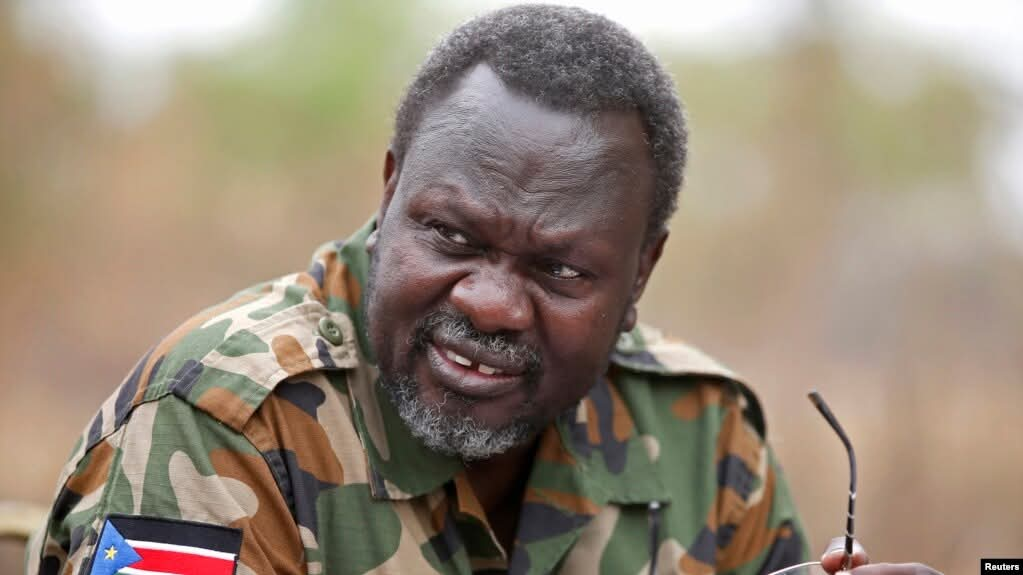
South Sudan Vice President Detained Amid Rising Tensions
Juba, South Sudan – March 27, 2025 – In a dramatic escalation of political tensions, South Sudan’s First Vice President, Dr. Riek Machar, was detained in the capital city of Juba, according to a statement released by the Chairperson of the Foreign Relations Committee of his party, the Sudan People’s Liberation Movement-in-Opposition (SPLM-IO). The arrest has sparked widespread concern both domestically and internationally, with fears that it could push the fragile nation back into the abyss of civil conflict.
Dr. Machar, a prominent figure in South Sudanese politics and a long-standing rival of President Salva Kiir, was reportedly taken from his residence in a heavily militarized operation. The SPLM-IO described the move as involving “20 heavily armed vehicles,” underscoring the scale and intensity of the security forces’ actions. The party has fiercely denounced the detention, labeling it an “unconstitutional act” and emphasizing that no clear justification has been provided by the government for Machar’s arrest.
The detention comes at a time of already heightened instability in South Sudan, a country that has struggled to maintain peace since gaining independence from Sudan in 2011. The rivalry between Machar and Kiir has been a central fault line in the nation’s politics, most notably fueling a devastating civil war from 2013 to 2018 that claimed tens of thousands of lives and displaced millions. A fragile peace agreement in 2018 established a unity government, with Machar serving as First Vice President, but distrust and sporadic violence have persisted
The United Nations Mission in South Sudan (UNMISS) swiftly responded to the news of Machar’s detention, warning that it risks plunging the country into a fresh wave of violence. Nicholas Haysom, the head of UNMISS, issued a statement urging all parties to exercise restraint and avoid actions that could lead to widespread conflict. “The leaders of South Sudan must prioritize dialogue and de-escalation,” Haysom said. “The people of this country have suffered enough.”
The UN’s concerns are not unfounded. Reports from the ground indicate that clashes between forces loyal to President Kiir and those aligned with Machar have erupted in the past 24 hours, particularly in areas surrounding Juba. While the full extent of these skirmishes remains unclear, they signal a dangerous deterioration of the security situation.
Adding to the sense of crisis, Norway and Germany announced the temporary closure of their embassies in Juba, citing the escalating instability. Both nations have been key players in supporting South Sudan’s peace process, and their decision underscores the gravity of the current moment.
Humanitarian Fallout
The detention and subsequent unrest have compounded an already dire humanitarian situation. According to the United Nations, nearly 50,000 people have been displaced from the White Nile region since last month, driven by ongoing violence and insecurity. The German broadcaster Deutsche Welle highlighted the scale of the displacement, noting that many of those affected are now without access to basic necessities like food, water, and shelter.
South Sudan’s humanitarian crisis is among the worst in the world, with millions facing food insecurity and a lack of essential services. The latest developments threaten to exacerbate these challenges, as aid agencies struggle to operate in an increasingly volatile environment.
A Nation on the Brink
Machar’s detention has raised questions about the future of South Sudan’s unity government and the broader peace process. The SPLM-IO has called for his immediate release and warned that the move could unravel years of fragile progress. Analysts suggest that the lack of transparency surrounding the arrest—coupled with the government’s failure to provide a clear rationale—may fuel speculation of a power grab by President Kiir’s faction.
For years, Machar has positioned himself as a counterweight to Kiir’s leadership, advocating for greater decentralization and representation for marginalized groups. His arrest could galvanize his supporters, many of whom are drawn from the Nuer ethnic group, potentially reigniting ethnic tensions that have long plagued the country.
As South Sudan teeters on the edge of yet another crisis, the international community is watching closely. The United States, a major backer of South Sudan’s independence, has yet to issue an official statement, but pressure is mounting for diplomatic intervention to prevent a full-scale collapse.
For now, the streets of Juba remain tense, with security forces deployed in large numbers. The fate of Riek Machar—and indeed, the nation itself—hangs in the balance as South Sudan confronts one of its most perilous moments in recent history.