
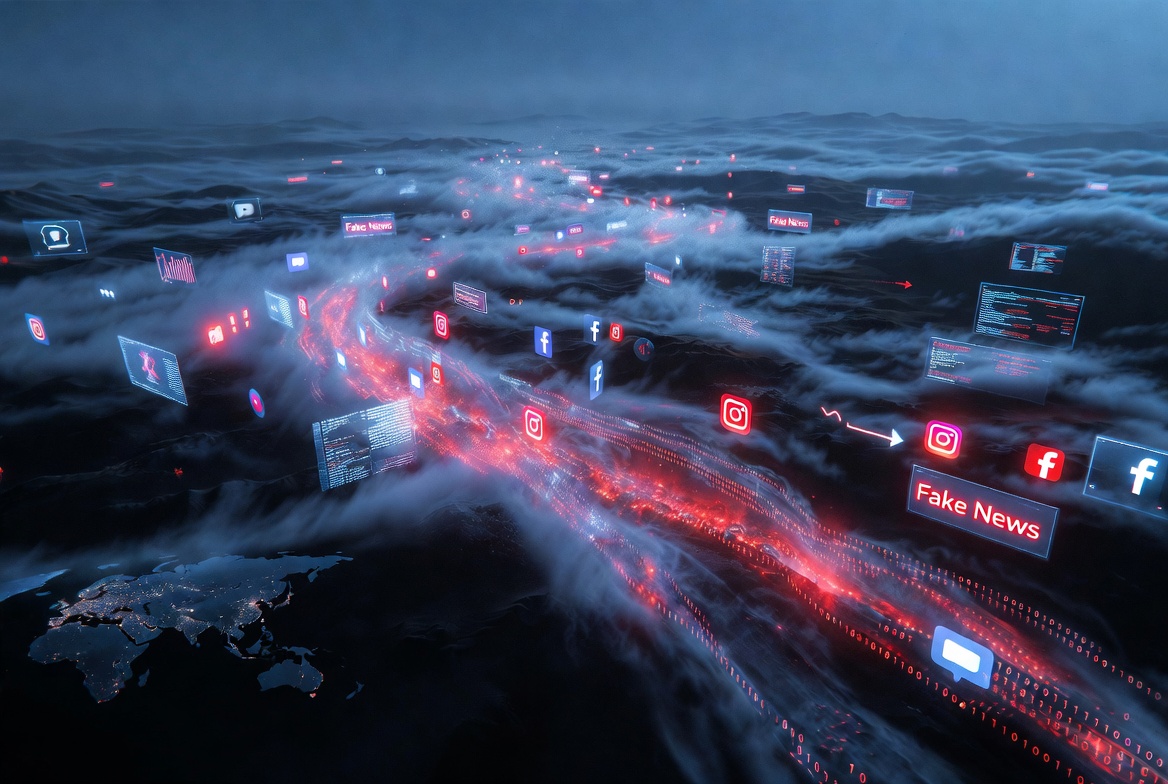
Lessons from Ukraine and the US–Israel–Iran Conflict
When missiles fly, truth is often the first casualty. In modern warfare, however, something spreads even faster than rockets: disinformation.
As tensions escalate in conflicts around the world, the battlefield is no longer limited to land, air, or sea. It now includes social media feeds, messaging platforms, and algorithm-driven recommendation systems. In these spaces, fabricated narratives, manipulated images, and AI-generated videos can travel across the globe in minutes—often reaching millions before verification catches up.
Recent military tensions involving the United States, Israel, and Iran illustrate how quickly misinformation can proliferate during crises. The phenomenon mirrors patterns seen in the prolonged Russia–Ukraine war, where information manipulation has become an integral component of strategy.
A Testing Ground: Disinformation in the Ukraine War
The Russia–Ukraine conflict has served as one of the clearest examples of large-scale information warfare in the digital age.
Since the early stages of the war, propaganda and coordinated online campaigns have attempted to shape international perception of the conflict. Narratives have ranged from denying documented atrocities to portraying Ukraine as controlled by extremist forces. Such claims have circulated through state media outlets, coordinated online accounts, and websites designed to imitate legitimate news organizations.
Bot networks have played a significant role in amplifying these messages. Thousands of automated or semi-automated accounts can rapidly repost identical narratives, giving the impression of widespread public opinion. During major military offensives, researchers have observed dramatic spikes in misleading or fabricated content circulating online.
These campaigns are not designed solely to convince audiences of a particular story. Instead, their goal is often to flood the information environment with conflicting claims, creating confusion and weakening trust in reliable reporting.
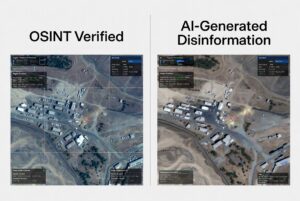
Despite these efforts, investigative journalists and open-source intelligence communities have repeatedly exposed fabricated claims. By analyzing satellite imagery, geolocation data, and digital forensics, independent researchers have demonstrated how transparent verification can counter misinformation.
The New Frontier: AI-Driven Disinformation
While the Ukraine conflict relied heavily on traditional propaganda methods, newer geopolitical crises reveal a shift toward more technologically sophisticated deception.
In recent tensions involving Iran, Israel, and the United States, fabricated visual content has circulated widely online. Some viral clips claiming to show missile strikes or destroyed military infrastructure were later traced back to video game footage, edited satellite imagery, or unrelated disasters from years earlier.
Advances in generative artificial intelligence are accelerating this trend. Tools capable of producing realistic images and videos allow manipulated content to be created quickly and cheaply. What once required specialized editing teams can now be generated within minutes.
The result is a new form of “visual misinformation.” Explosions, missile launches, and damaged cities—imagery that appears convincing at first glance—can be fabricated and shared before fact-checkers have time to respond.
In the fast-moving environment of modern conflict, such content can shape perceptions long before the truth emerges.
Information Warfare and Public Perception
Disinformation campaigns rarely aim only at domestic audiences. Their influence is global.
In the Ukraine war, misleading narratives have attempted to erode international support for Kyiv. Similarly, misleading claims in Middle Eastern conflicts can influence how global audiences interpret military actions, civilian casualties, or diplomatic decisions.
For ordinary citizens trying to follow events online, distinguishing between authentic reporting and fabricated material becomes increasingly difficult. Viral posts can accumulate millions of views within hours, regardless of their accuracy.
The speed and scale of digital communication mean that once misinformation spreads widely, correcting it becomes significantly harder.
Defending the Information Space
The response to disinformation must evolve alongside the technology that enables it.
Independent journalism remains one of the most effective defenses. Investigative reporters, digital forensic analysts, and open-source intelligence communities continue to expose manipulated content through transparent verification methods.
Technology platforms also face increasing pressure to improve detection systems capable of identifying AI-generated media and coordinated influence campaigns.
For readers and viewers, the most powerful defense is skepticism and verification. Checking multiple sources, recognizing emotionally manipulative headlines, and waiting for confirmation before sharing dramatic claims can significantly slow the spread of misinformation.
The Future Battlefield

Modern wars are fought with missiles, drones, and cyber tools—but they are also fought with narratives.
The ability to shape perception can influence diplomatic pressure, public opinion, and international alliances. In this environment, controlling the story of a conflict can be nearly as powerful as controlling territory.
As artificial intelligence lowers the cost of creating convincing deception, the struggle for credible information will only intensify. If societies cannot defend the integrity of the information space, the fog of war may become permanent.
In the conflicts of the twenty-first century, truth itself has become a strategic asset.