
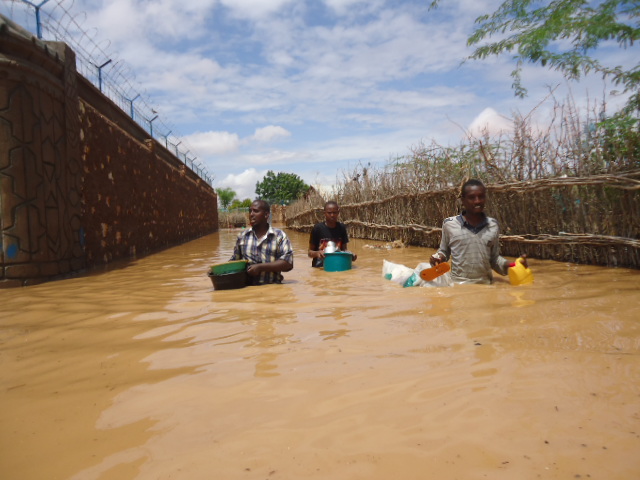
Severe flooding driven by a very strong El Niño could force up to three million people from their homes across Somalia, Kenya, South Sudan and Uganda before the end of the year, the UN refugee agency warned on Friday, as it urged world leaders to steer more climate money toward people already displaced by war.
The warning came in a new UNHCR report released ahead of the COP31 climate conference, which Türkiye hosts in Antalya from 9 to 20 November. The agency said its projections for East Africa range from about 770,000 to three million people displaced, depending on how heavy the rains turn out to be during the current October to December season.
A region still recovering from 2023
The figures build on modelling published in August by the Danish Refugee Council, which set out three scenarios for the season. In the worst case, the group estimated, Somalia would account for roughly 60 percent of displacements and Kenya about a third, with communities along the Juba and Shabelle rivers in Somalia and the Tana River basin in Kenya among the most exposed.
UNHCR said floods linked to the last strong El Niño displaced more than two million people in 2023, with some families forced to flee several times.
‘A double injustice’
The East Africa projection is one part of a wider global picture. According to UNHCR, nearly 90 million forcibly displaced people, about three in four worldwide, now live in countries facing high to extreme exposure to climate hazards such as droughts, floods and extreme heat. More than two in three refugees who returned home in the first half of 2026 went back to countries highly vulnerable to those hazards, the agency said.
“Refugees face a double injustice. Forced to flee conflicts they did not cause, they are now on the frontlines of a climate crisis they have contributed least to,” said Antón Leis García, UNHCR’s Assistant High Commissioner for Operations.
The report also points to rising heat in refugee settlements. By 2050, it said, one in three settlements across sub-Saharan Africa could face at least 100 days of dangerous heat a year. In some settlements in Ethiopia, including Helaweyn in the Somali region, dangerous heat could last more than 200 days a year, according to the agency.
Money not reaching the most exposed
UNHCR said fragile and conflict-affected countries receive only around 10 percent of global climate finance, even though many host large numbers of refugees. At COP31, it plans to ask governments and climate funds to include displaced people in national climate plans and to shift from short-term emergency aid toward longer-term adaptation.
“We need climate financing to reach the communities where the needs are greatest,” Leis García said, adding that refugees and their hosts “must be part of these investments, not an afterthought.”
Whether the worst-case scenario materialises will depend on rainfall over the coming weeks. The Danish Refugee Council calls its estimates tentative.
Sources
- UNHCR: Ahead of COP31, UNHCR warns nearly 90 million displaced people face severe climate risks
- TRT Afrika / Anadolu Agency: UN agency warns El Nino could displace 3 million people in east Africa
- Danish Refugee Council: El Niño to supercharge East Africa flooding
Photo: Residents of Beletweyne, Somalia, wade through floodwater in 2012 (file photo). Oxfam East Africa, Wikimedia Commons, CC BY 2.0.
