
A Spanish-Ethiopian team has wrapped up its second season on the Entoto mountains above Addis Ababa. What it found reads like a 1,500-year history of the highlands in one hillside: a farming village, standing stones, a burned layer, a fortified farm, and a stone house abandoned within living memory.
By HahuPrime News Desk | November 1, 2026
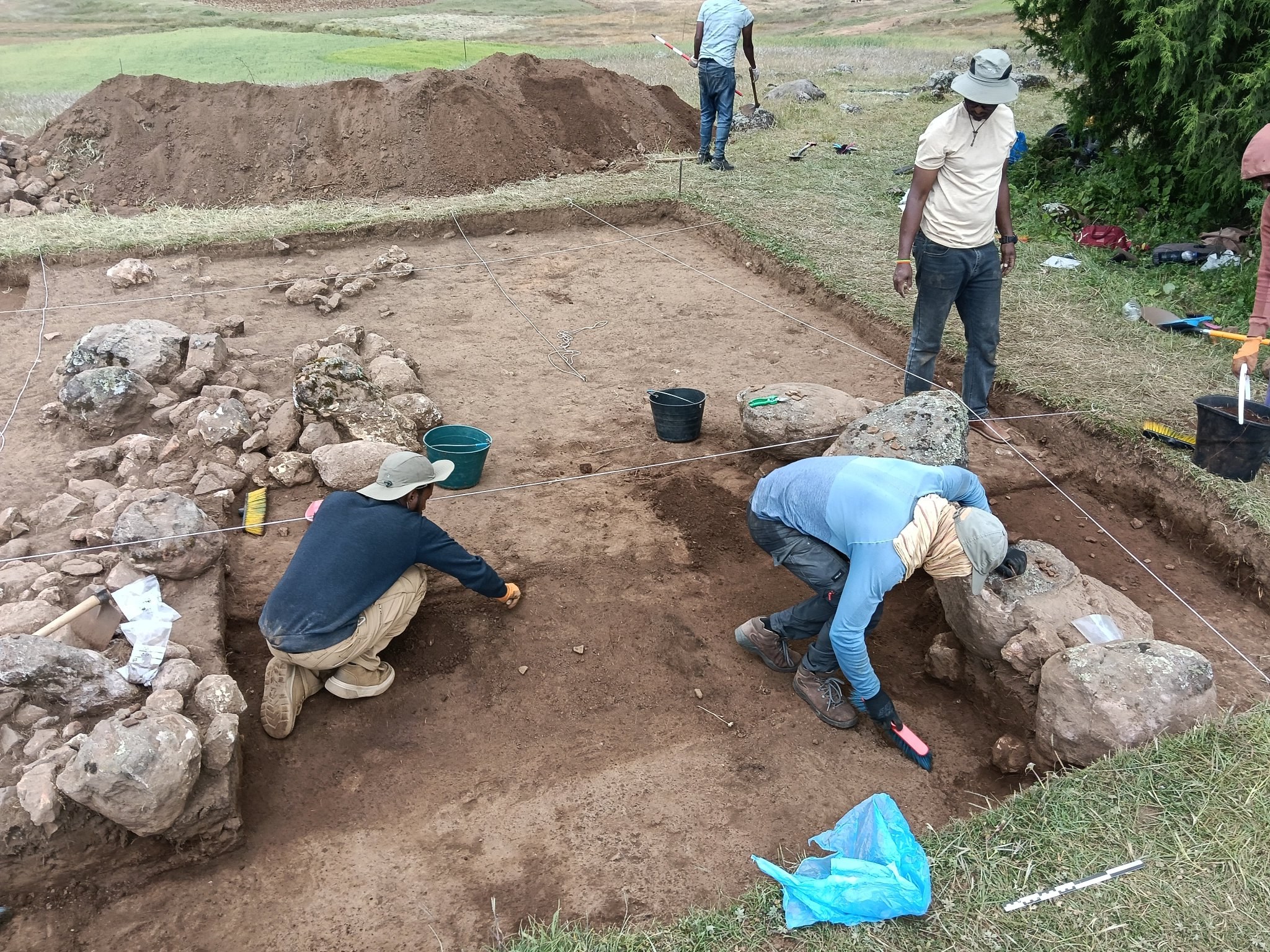
ADDIS ABABA — On a grassy slope near the village of Akako, about 3,000 metres up in the Entoto mountains, a grey stone stands upright in a fresh trench, a red-and-white measuring rod at its foot. Nearby, farmers still thresh barley the old way, driving cattle over the cut stalks. The archaeologists who spent the last three weeks digging here say the people who lived on this spot fifteen centuries ago grew the very same crop.
“Today we finished our archaeological campaign in Ethiopia,” Alfredo González-Ruibal, an archaeologist at Spain’s Institute of Heritage Sciences (Incipit-CSIC), wrote on X on October 30. He summed up the results as “1,500 years of African history” in a ten-part thread that has been viewed more than 34,000 times.
The dig is part of a five-year project run by Incipit-CSIC with Addis Ababa University, the Djibouti Centre for Research and Studies and the National Museum of Somaliland. This was its second field season, González-Ruibal said in a reply on X, and each season involves three weeks in the field. The project is funded by Spain’s Ministry of Science, Innovation and Universities and by CSIC’s scientific cooperation programme.
A village older than the city
According to the team, a community of farmers founded a village on the Entoto ridge around the fifth or sixth century AD, long before Addis Ababa existed. They grew barley, which González-Ruibal notes is, along with wheat, “the only cereal that really does well” at that altitude. They dug with digging sticks and buried their dead under large stone mounds.
Who were they? The team does not claim to know for certain. Its working answer is that they were close cousins of people who lived more than 500 kilometres to the east, around Harar. The evidence is in the pottery. “The Entoto assemblage has exactly the same bowl and jar shapes, ochre fabrics and plastic decorations as Hassan Abdi and Mole,” González-Ruibal wrote, referring to sites near Harar studied by the French archaeologist Roger Joussaume in the 1970s and linked to what is often called the Chercher culture. He has suggested the villagers may have been Harla, a people about whom, he wrote, “we know very little”. That identification remains a hypothesis.
The team also found a small amount of imported pottery from the Shay culture of northern Shewa, which it describes as very different from the local wares.
Standing stones in the middle of a village
By the 13th century, the team says, the village sat on a dangerous frontier between three powers: the Sultanate of Ifat, the Christian Ethiopian kingdom and the kingdom of Damot, a little-studied non-Christian state south of the Blue Nile to which the village probably belonged.
It was in this period that people raised ignimbrite stelae, standing stones dedicated, in the team’s reading, to their gods or ancestors. In an article for National Geographic Historia published in April, González-Ruibal wrote that the stones are unusual. In southern Ethiopia, monoliths usually mark graves, a tradition almost two thousand years old. At Akako, the excavators found no burials beneath them, only cooking pottery and obsidian flakes used for working hides or wood. They also found a gebeta board, the mancala-style game still played across much of Africa, carved into a rock.
He pointed to ethnography for an explanation. Until recently, groups in southern Ethiopia such as the Konso, Gewada and Maale placed monoliths in the middle of their villages, near homes or meeting places, to represent legendary ancestors, dead relatives, or war and hunting trophies.
The same article describes a second site higher up the mountains: a stone tumulus more than 40 metres long and about 10 metres high, among the largest recorded in the Horn of Africa. It is too big to excavate for now.
Fire, a fortified farm and a war
Damot is known mainly from Ethiopian royal chronicles and medieval Muslim geographers, who described a powerful kingdom with gold mines and a king said to practise sorcery. The chronicles record that Emperor Amda Seyon (reigned 1314–1344) conquered it early in his reign.
The excavation appears to have caught that moment in the ground. The team says radiocarbon dates place the village’s end around the late 13th or early 14th century, and González-Ruibal wrote that “around 1317” the settlement was destroyed, leaving “only a layer of charcoal and burnt pottery”. He described the wider campaign as one in which the Christian kingdom conquered Damot, deported thousands and converted the rest. That account rests on the chronicles and the team’s dating; it has not yet appeared in a peer-reviewed publication.
On top of the ashes, according to the team, the new rulers built a fortified farm to control the conquered land, reusing the old stelae as building stones for a defensive wall. That settlement did not last long either. The team believes it may have disappeared during the 1529–1543 war between the Adal Sultanate and the Ethiopian kingdom, which devastated the region. Churches destroyed in that period have been excavated nearby. González-Ruibal added in a reply that the abandonment could also date to the Oromo expansion that followed.
In the late 16th century, Oromo communities settled in the area. On top of the millennium-old village, of which no visible trace remained, they built a stone house. It was abandoned in the mid-20th century.
Reading a contested past
Medieval Ethiopian history is politically charged, and the thread drew pointed replies. Asked about his framing, González-Ruibal wrote: “We try to be sensitive and avoid loaded terms, but history is what it is and I have the impression that people will find their way to manipulate archaeological data for ideological purposes no matter how we present them.”
He also stressed that the finds stay in Ethiopia. “Everything stays in the country,” he wrote in Spanish. “We only export samples for laboratory analysis. Ethiopia has a wonderful National Museum.” In another reply he said the museum’s collections are “absolutely outstanding” and “deserve a better, larger container”.
For a city that often dates its own story to Emperor Menelik II’s founding of Addis Ababa in the 1880s, the dig is a reminder that the hills above it were lived in, fought over and farmed for more than a thousand years before that. HahuPrime has written before about the region’s long history of ancient trade routes and about how Ethiopia’s past shapes its present.
González-Ruibal closed his thread on the people who outlasted every kingdom. “Over 1,500 years, religions changed, some ethnic groups displaced others, languages died out, kingdoms rose and fell,” he wrote. “Perhaps because the farmers are still there. Caring for the land and for memory.”
Sources
- X: Alfredo González-Ruibal (@GuerraenlaUni), thread on the end of the Entoto excavation season, October 30, 2026, and replies, October 30–31, 2026
- National Geographic Historia: En busca de Damot, un reino pagano en Etiopía (Alfredo González-Ruibal), April 2026
- Incipit-CSIC: Alfredo González-Ruibal, researcher profile
- African Archaeological Review: Landscapes of Memory and Power: The Archaeology of a Forgotten Kingdom in Ethiopia (González-Ruibal, 2024)
- elDiario.es: El arqueólogo Alfredo González Ruibal, Premio Nacional de Ensayo 2024