
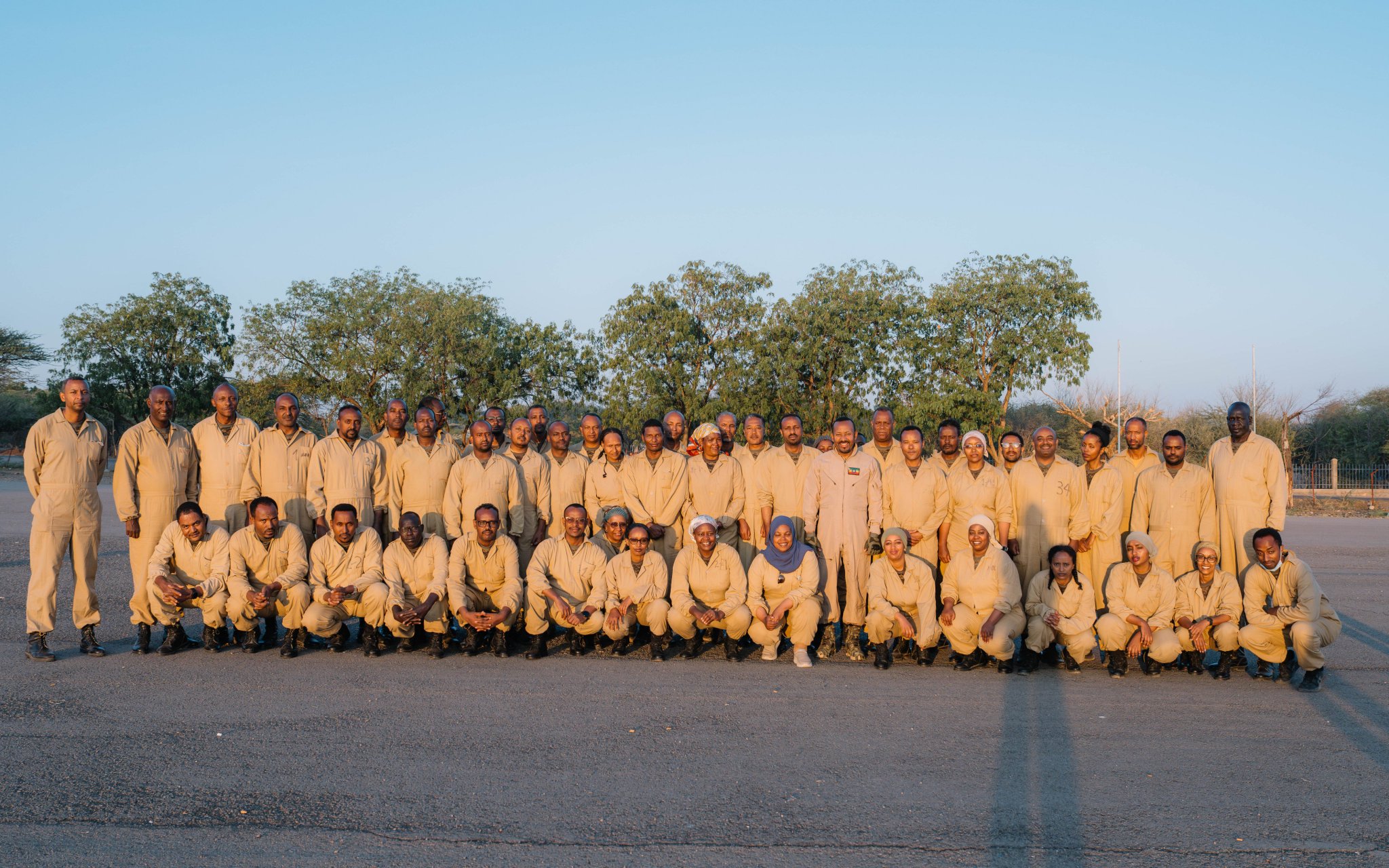
Ethiopia’s prime minister has taken his cabinet to the Hurso military training centre, saying the discipline of soldiers will make better civilian leaders. The photos landed in a week of drone strikes in the north and a deep freeze with Eritrea.
By HahuPrime News Desk | October 31, 2026
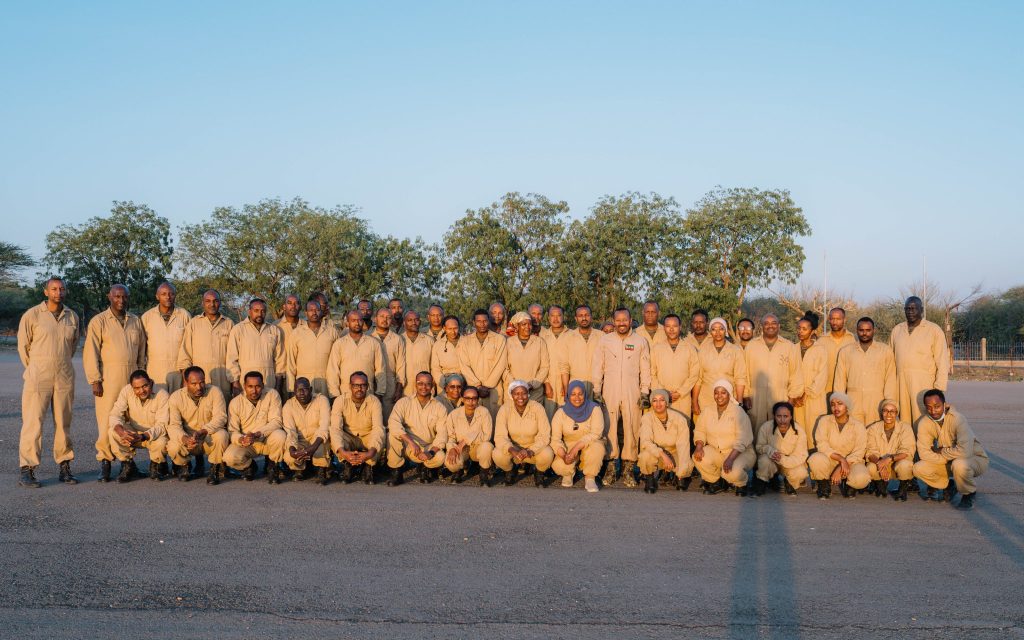
HURSO, Ethiopia — The finance minister was in fatigues. So was the health minister. In photos Prime Minister Abiy Ahmed shared on Saturday, the people who usually sit behind ministry desks in Addis Ababa are lined up on a dusty training ground in eastern Ethiopia, taking part in military exercises alongside the man who runs the country.
Abiy has put his cabinet ministers, deputy ministers and the heads of government institutions through training at the Hurso military training centre, about 40 kilometres west of Dire Dawa. Among those taking part, according to the BBC, are Muferiat Kamil, the speaker of the House of Federation, Finance Minister Fitsum Assefa and Health Minister Mekdes Daba.
“Soldiers have targets while civilians have goals. The objective of both is victory,” Abiy wrote in his post, as translated by the BBC.
It is not clear when the training began or how long it will last. The government has not published a curriculum, a schedule or a list of everyone involved.
What Abiy says the training is for
Abiy framed the exercise as part of his larger project. Ethiopia’s ambition of what he calls comprehensive prosperity, material and spiritual, needs leaders who are “physically fit, morally strong, intellectually capable”, he said, according to the state-affiliated Fana Media Corporation.
He listed what he thinks civilians can borrow from soldiers: carrying out orders effectively, patriotic service, work discipline, constant readiness, accountability and coordination at every level. Senior officials of what he calls the “Medemer Government”, after his governing philosophy of synergy, are at Hurso to gain “knowledge, skills, and experience” for carrying out the “grand strategy of the Medemer civilization”, Fana reported.
He also named national security directly. Among the goals he gave were building “a resilient nation that cannot be intimidated” and “ensuring national security at all times”. Combining military precision with civilian purpose, he argued, would produce a generation able to hit both narrow targets and wider national objectives.
For Ethiopia this is new. Senior civilian officials are rarely seen in uniform or on a training range, the BBC noted. Abiy himself is a former army lieutenant colonel who served in military intelligence before entering politics, and he has often put military readiness at the centre of his speeches. Putting a whole cabinet through the same drill is a different step.
A camp built for peacekeepers
Hurso is not a ceremonial venue. The camp near the Addis Ababa–Djibouti railway in the Somali region has for years been where Ethiopian battalions prepare before deploying on African Union and United Nations missions in Somalia, South Sudan and Darfur. Its pre-deployment courses usually last about three months, and around 11,500 troops pass through each year, according to the Africa Defense Forum, a magazine published by the US Africa Command. American soldiers have trained alongside Ethiopian troops there, most visibly during the Justified Accord exercise in 2019.
Sending ministers to the same camp that prepares soldiers for Mogadishu carries a message. Whether that message is aimed at the public, at the ruling Prosperity Party’s own ranks or at Ethiopia’s neighbours, the government has not said.
A country under strain
The timing is hard to miss. Since late September federal forces have been fighting the Tigray People’s Liberation Front (TPLF) and allied armed groups across Tigray, Afar and Amhara. Federal troops and the pro-government Tigray Peace Force retook Mekelle in early October, and the army has since pushed up to the Eritrean border.
The war has been hard on civilians. Multiple drone strikes in northern Ethiopia since Thursday have killed at least 25 civilians, including children, witnesses and a medical source told AFP. In Amhara, a witness said four strikes “were carried out one after another” on a camp for displaced people. “We have buried 14 people at the IDP centre. Two more died while receiving medical treatment,” a man who gave his name only as Yasin told the agency. Responsibility for the camp strike has not been independently confirmed. In Tigray, a second strike on a grain lorry in the town of Rama killed at least 11 people collecting spilled sorghum, according to AFP; the conflict monitor ACLED said that strike was believed to have been carried out by the federal army.
Relations with Eritrea are at their lowest point since Abiy’s 2018 peace deal with President Isaias Afwerki, the rapprochement that helped win him the Nobel Peace Prize. On October 1 Ethiopia closed its embassy in Asmara and expelled 10 Eritrean diplomats, accusing Asmara of “direct and indirect acts of hostility and belligerence”. Eritrea responded by cutting all diplomatic ties and accused Addis Ababa of a “publicly pronounced declaration of war” over its push for access to the Red Sea. Eritrea denies supporting the TPLF.
Ethiopia is also rearming. Abiy has announced plans to acquire 12 Russian Su-35 fighter jets and S-400 air-defence systems. In the south, fighting tied to a boundary dispute between the Oromia and Somali regions has driven up to 50,000 people across the border into Kenya near Moyale, UN agencies say.
What comes next
Supporters will see a leader asking his ministers to share some of the hardship of the soldiers fighting in their name. Critics are likely to ask why the cabinet is drilling at Hurso while displaced families in Amhara bury their children and aid agencies appeal for money to shelter people fleeing Moyale.
The government has given no sign that ministers’ day-to-day work has been handed to deputies while the training lasts, or that it plans to extend the programme to regional officials. What is clear is the direction of travel. With fighting in the north, tension on the Eritrean border and new Russian hardware on order, Abiy is asking the people who run Ethiopia’s civilian state to think, at least for a while, like soldiers.
Sources
- BBC News: Ethiopian PM Abiy Ahmed puts ministers through military training
- Fana Media Corporation: PM Abiy Ahmed Underscores Military Training’s Role in Building Capable, Disciplined National Leadership
- Sputnik Africa: Leaders of Ethiopia’s ‘Medemer’ Government Undergo Training at Hurso Military Training Center
- AFP via Africanews: Drone strikes in Ethiopia kill at least 25: witnesses
- BBC News: Ethiopia and Eritrea cut diplomatic ties as Tigray conflict escalates
- Al Jazeera: Eritrea severs diplomatic ties with Ethiopia in tit-for-tat move
- Arab News: Ethiopia raises the stakes with latest Red Sea gamble
- Africa Defense Forum: Upholding a Peacekeeping Tradition