
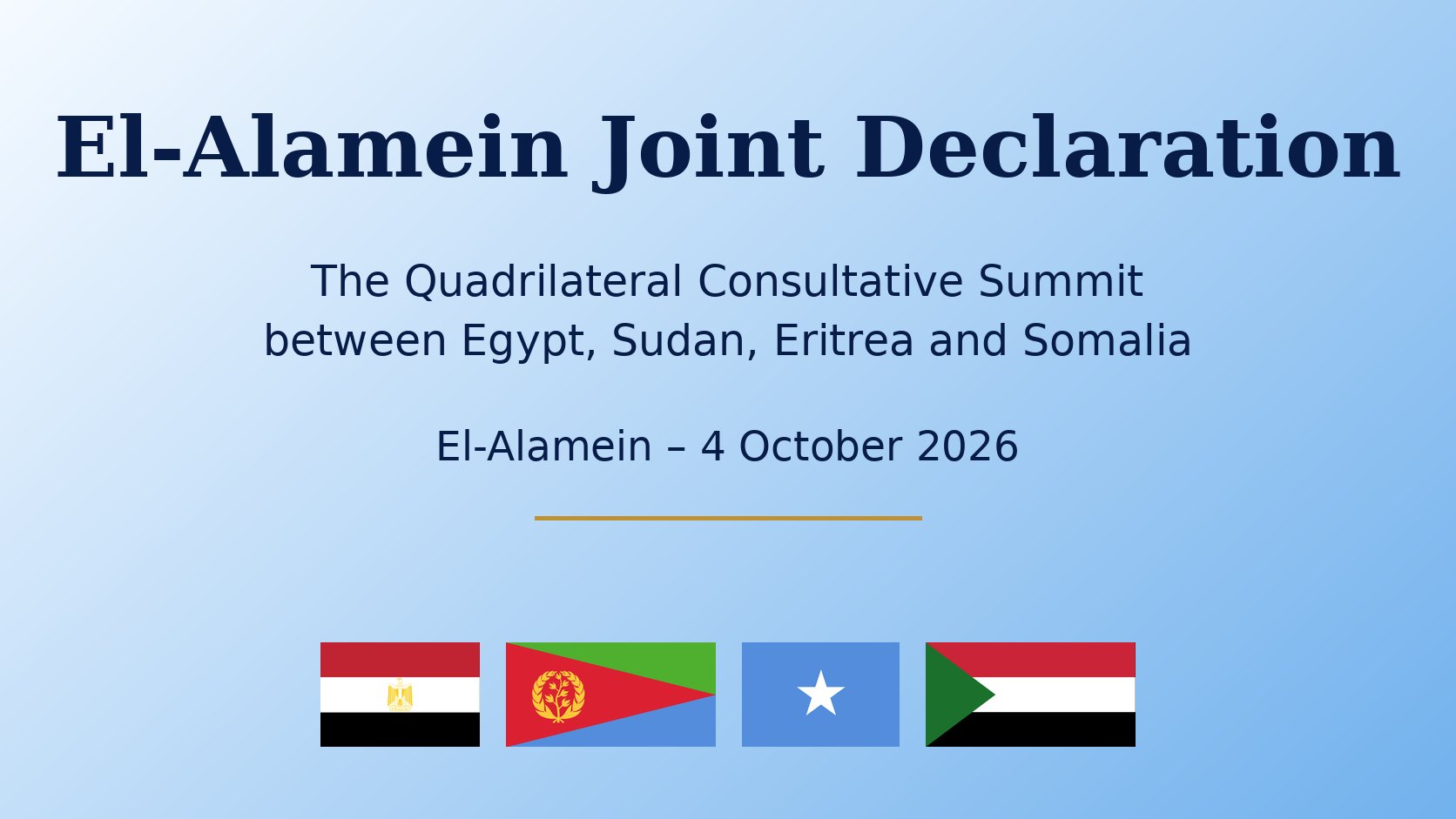
El-Alamein declaration: Egypt, Eritrea, Somalia and Sudan reject Somaliland recognition and unilateral Nile steps
Leaders meeting in New Alamein set a joint line on Sudan, Somalia, Red Sea governance and the Nile. The text does not name Ethiopia. It was issued days after Addis Ababa and Asmara severed diplomatic ties, and as fighting continued in northern Ethiopia.
By HahuPrime News Desk, 5 October 2026
New Alamein, Egypt — The leaders of Egypt, Eritrea, Somalia and Sudan issued a joint declaration on Sunday affirming sovereignty and territorial integrity and setting common positions on Sudan, Somalia, the Red Sea and the Nile.
Egyptian President Abdel Fattah el-Sisi hosted Eritrean President Isaias Afwerki, Somali President Hassan Sheikh Mohamud and General Abdel Fattah al-Burhan, chairman of Sudan’s Transitional Sovereignty Council. The meeting, described in the text as a quadrilateral consultative summit, was held in New El Alamein City on 4 October 2026 at el-Sisi’s invitation.
The El-Alamein Joint Declaration, published by Eritrea’s Ministry of Information as an unofficial translation and carried by Egyptian outlets, does not name Ethiopia. Regional reporting has nonetheless read several of its clauses against Ethiopian policy on the Nile, access to the sea, and the self-declared Republic of Somaliland.
What the leaders agreed
According to the published text, the four leaders agreed to:
– Support Sudan’s unity, sovereignty, territorial integrity and national institutions; reject the establishment of parallel entities; encourage resumption of a Sudanese-owned and Sudanese-led political process; and “categorically” reject any support for mercenaries.
– Support Somalia’s unity and sovereignty and reject interference aimed at undermining them, “particularly recognition of what is referred to as ‘Somaliland.’”
– Back Somalia’s counter-terrorism efforts and the extension of state authority across the country, and call on partners to provide adequate, sustainable and predictable funding for the African Union Support and Stabilization Mission in Somalia (AUSSOM).
– Affirm freedom of navigation and state that governance of the Red Sea is the exclusive responsibility of littoral states.
– Affirm respect for international law on transboundary rivers, including the Nile, “particularly the principle of non-harm,” and cooperation through prior notification, consultation and consensus, while rejecting unilateral measures that adversely affect existing water uses of the two downstream countries.
– Continue to strengthen consultation and coordination among the four countries, and establish a follow-up mechanism that will meet periodically and whenever necessary.
The declaration also restates broader principles: respect for sovereignty, stability and territorial integrity; good-neighbourliness; rejection of interference in internal affairs “under any pretext”; and support for national institutions and political solutions to conflicts. The visiting leaders thanked Egypt for hosting the summit.
The Nile clause in the Eritrean ministry’s unofficial translation uses “non-harm.” Some Egyptian reports rendered the same passage as “no significant harm,” the formulation more familiar from international water law. HahuPrime has not independently compared the Arabic original.
The wider setting
The summit followed a sharp deterioration in relations between Ethiopia and Eritrea. On 1 October, Ethiopia said it was closing its embassy in Asmara and ordered 10 Eritrean diplomats to leave within 48 hours, accusing them of activities that threatened national security. Eritrea said it was severing diplomatic ties in response. Ethiopia has accused Eritrea, and also Egypt and Sudan, of supporting an armed opposition alliance that includes the Tigray People’s Liberation Front. Officials of the three countries have denied involvement, according to Reuters and Al Jazeera.
Fighting has resumed in northern Ethiopia between federal and allied forces and the TPLF and its partners. Al Jazeera reported that government forces retook Mekelle on Sunday after the TPLF said it had temporarily left the Tigrayan capital. Casualty figures and the wider military picture remain incomplete.
Sudan has been at war since April 2023 between the army, led by al-Burhan, and the paramilitary Rapid Support Forces. The declaration’s language on national institutions, parallel entities and mercenaries aligns with the position of the army-led authorities in Port Sudan. It does not set out a mediation plan.
On the Red Sea, the leaders limited governance to littoral states while restating freedom of navigation. Ethiopia, which is landlocked, has sought sovereign sea access and a naval presence. Somali President Hassan Sheikh Mohamud told Al Jazeera on Saturday that Mogadishu does not object to Ethiopian commercial access through Somali ports if it is agreed with Somalia. That distinction is not in the declaration.
Egypt and Sudan have long disputed Ethiopia’s Grand Ethiopian Renaissance Dam. The declaration’s Nile paragraph refers only to “the two downstream countries” and does not name the dam or Ethiopia.
Egyptian and regional outlets, including Egypt Today, the Egyptian Gazette, Daily News Egypt and Xinhua, described the outcome as a coordinated stance on Horn of Africa and Red Sea security. The National, citing unnamed sources before the meeting, reported that deeper military cooperation might be discussed. No such measures appear in the published declaration. Claims of a formal security pact remain unconfirmed.
What happens next
The four governments agreed only to a periodic follow-up mechanism. No date was announced. Whether the declaration changes positions on Somaliland recognition, Nile negotiations or Red Sea access will depend on later diplomacy, not on the text itself. Ethiopia had not, at the time of publication, issued a detailed response to the declaration in the sources reviewed.