
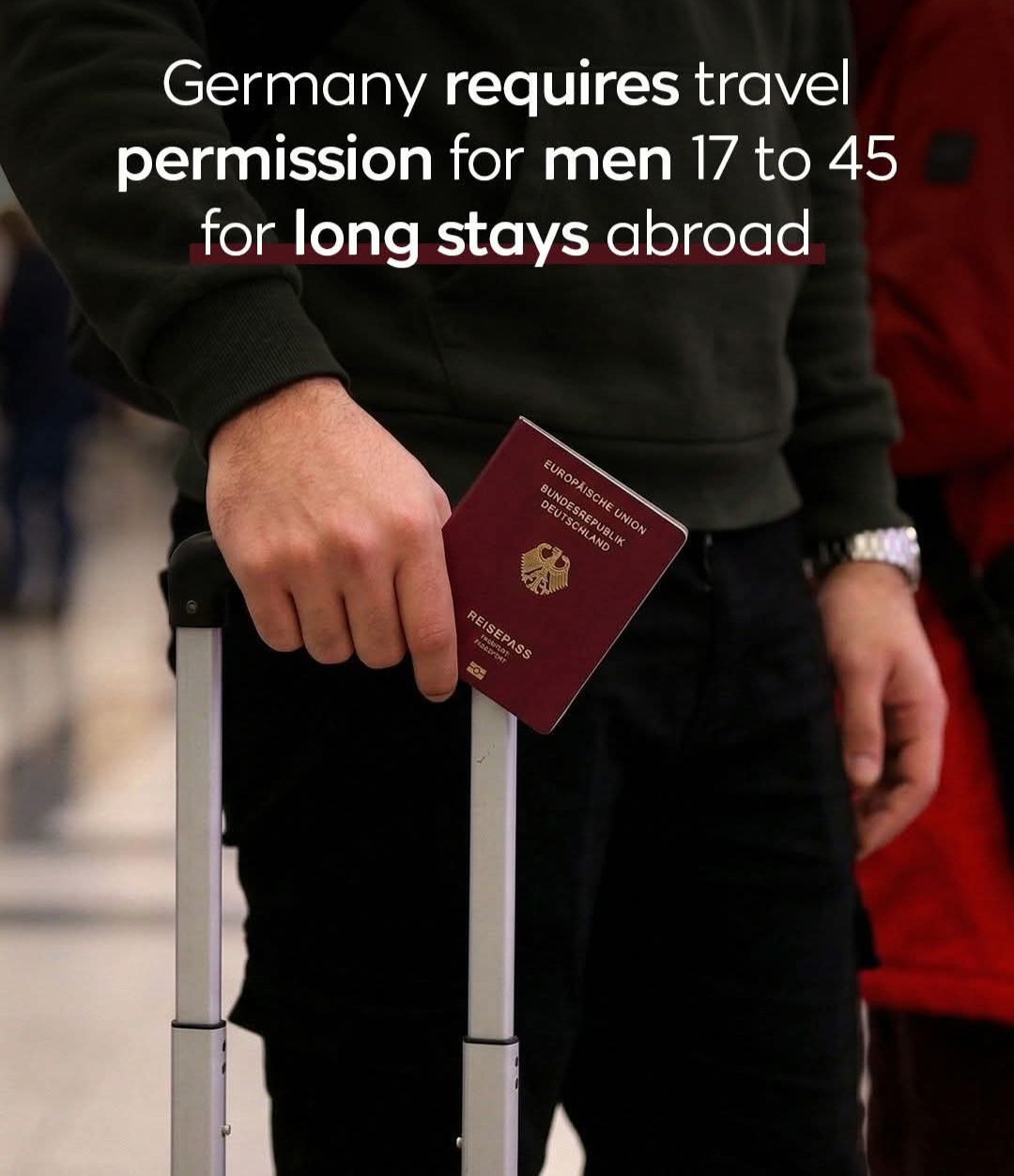
As of January 1, 2026, men in Germany between the ages of 17 and 45 are required to obtain official permission from the Bundeswehr (German armed forces) before leaving the country for more than three months. This change, part of the “Military Service Modernization Act”(Wehrdienst-Modernisierungsgesetz), has sparked discussion after receiving relatively little initial public attention when it quietly entered into force.
The rule applies to any extended stay abroad, regardless of purpose—whether for university studies (such as a semester or full degree abroad), employment, long-term travel, work & travel programs, family visits, or other reasons. It also covers situations where an individual wishes to extend a previously approved stay or prolong an initially shorter trip beyond the three-month threshold. Applications for permission must be submitted to the responsible “Bundeswehr career center” (Karrierecenter der Bundeswehr), which serves as the military’s recruitment and administrative offices across the country.
According to the revised wording in the Wehrpflichtgesetz (Military Service Act), specifically Paragraph 3, male persons who have reached the age of 17 must obtain this authorization from the competent Bundeswehr career center if they intend to leave the Federal Republic of Germany for longer than three months. The obligation ends upon reaching the age of 45. This requirement now applies in peacetime and normal circumstances, not only during a declared “tension” or defense situation as was previously the case.
German defense ministry officials have emphasized that the measure is primarily administrative and aimed at improving record-keeping. In the event of a national emergency or potential mobilization, authorities want to maintain an accurate overview of where eligible individuals are located. A spokesperson for the Federal Ministry of Defense told media outlets that the goal is to know “who might be abroad for a longer period” if needed. However, they also clarified that, as long as military service remains voluntary (with no general conscription currently in place), permissions are expected to be granted routinely. Administrative instructions will make clear that approval is effectively automatic in the current voluntary context.
This provision builds on elements that existed in older versions of German military law but were limited to crisis scenarios. The Military Service Modernization Act, which took effect at the start of 2026, also reintroduces mandatory military medical examinations (Musterung) for young men starting with certain birth cohorts (from 2008 onward). While actual conscription (Wehrpflicht) is not being reinstated at present—service stays voluntary for now—the law is widely seen as preparation for strengthening the Bundeswehr amid shifting security challenges in Europe, including concerns over regional stability.
The exit permission rule has been described by some outlets as a “reactivation” or expansion of an existing framework rather than an entirely new invention. Critics and commentators on social media have raised questions about its implications for personal freedom, gender equality (as it applies only to men), and potential bureaucratic hurdles for young professionals, students, and expats. Supporters argue it is a pragmatic step for national defense planning in an uncertain geopolitical environment, without imposing outright travel bans.
In practice, many reports suggest the process is not intended to restrict movement significantly under current conditions. No widespread reports of denials have emerged yet, and the ministry has stressed that the focus is on registration rather than prohibition. Still, failing to obtain the required permission could theoretically lead to administrative or legal complications if a crisis arises later.
Reactions and Public Discussion
The rule gained broader visibility in early April 2026 after coverage in outlets like the ‘Frankfurter Rundschau’, ‘Berliner Zeitung’, ‘ZEIT’, and ‘Handelsblatt’. Discussions have proliferated on social media, with some viewing it as a sign that Germany is “gearing up” for potential future conflicts, while others downplay it as routine administrative modernization with minimal real-world impact for most people today.
It remains to be seen how smoothly the application process will function for the estimated millions of men in the affected age group who study, work, or live abroad. Authorities have not yet detailed exact timelines, required documents, or online application options, but more guidance is expected as implementation proceeds.
This development reflects ongoing efforts to adapt Germany’s defense posture while balancing civil liberties. For now, the permission is framed as a notification and approval mechanism rather than a barrier—though its existence marks a notable shift in how long-term mobility intersects with military administrative needs in peacetime Germany.
Source: News week and German Midia reports