
By Mulugeta Tesfaye
March 27, 2026
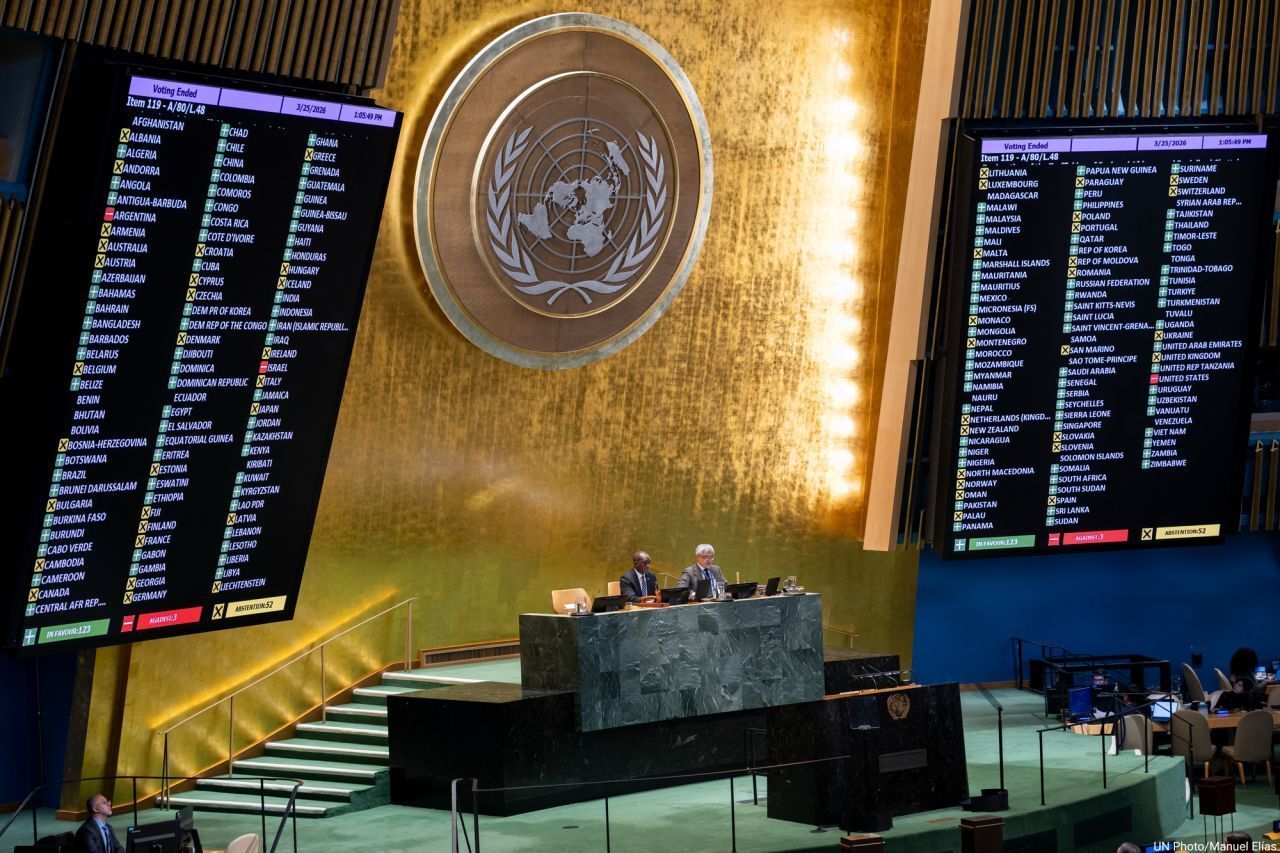
Applause echoed through the United Nations General Assembly hall on March 25 as member states adopted a landmark resolution declaring the transatlantic slave trade the “gravest crime against humanity.” For many, the moment marked a long-overdue recognition of one of history’s most devastating systems of exploitation. For others, it raised difficult questions about how humanity chooses to remember its past.
The resolution, formally titled A/80/L.48, was introduced by Ghana and strongly backed by the African Union and Caribbean nations. It passed with 123 votes in favor, three against — the United States, Israel, and Argentina — and 52 abstentions, including all European Union member states and the United Kingdom.
Timed to coincide with the International Day of Remembrance of the Victims of Slavery and the Transatlantic Slave Trade, the text describes the transatlantic system as a “definitive break in world history” due to its scale, duration, and institutionalized brutality. It further argues that the legacy of this system continues to shape modern societies through persistent inequalities in wealth, opportunity, and social structures.
At its core, the resolution calls for “reparatory justice.” It urges nations to consider formal apologies, educational initiatives, financial contributions, and the return of cultural artifacts as steps toward addressing historical injustices.
Along-Awaited Recognition
Between the 15th and 19th centuries, an estimated 12 million Africans were forcibly transported across the Atlantic Ocean. Around 10.7 million survived the brutal Middle Passage, only to face lives defined by forced labor, violence, and systemic dehumanization in the Americas.
Historians widely agree that the transatlantic slave trade was distinct not only for its scale but for its racial foundation. It institutionalized the idea that entire groups of people could be treated as property based on race — a legacy that continues to influence global social and economic inequalities.
Supporters of the resolution argue that this recognition is not about assigning blame, but about acknowledging historical truth and its ongoing consequences.
“This is about dignity,” one Caribbean diplomat said following the vote. “It is about recognizing that the past is not truly past when its effects are still visible in the present.”
For many nations in the Global South, the vote represents a broader push to address historical imbalances and to assert moral authority in international discussions that have long been dominated by Western powers.
Legal Concerns and Political Resistance
Despite widespread support, the resolution faced notable opposition and hesitation.
The United States, one of the three countries to vote against the measure, acknowledged the historical injustice of slavery but rejected the idea that it could create a legal basis for reparations. Officials emphasized the principle of non-retroactivity in international law — the idea that actions cannot be judged by legal standards that did not exist at the time.
Other concerns focused on the language of the resolution itself. By labeling the transatlantic slave trade as the “gravest” crime against humanity, critics argued that the measure risks creating a hierarchy of suffering.
Several countries pointed to other historical atrocities — including genocides and mass killings — questioning whether it is appropriate or constructive to rank human tragedies.
European nations, while recognizing the horrors of the slave trade, largely abstained. Their statements reflected a careful balance: acknowledging historical responsibility while avoiding implications of legal or financial liability.
Debate Over Historical Scope
Beyond legal and political concerns, the resolution has sparked broader debate about historical representation.
Critics note that the focus on the transatlantic slave trade, while justified in many respects, does not fully capture the global history of slavery. Systems of human bondage existed across continents and civilizations for centuries, including trans-Saharan and Indian Ocean slave trades, as well as widespread forms of enslavement within Africa, Europe, the Middle East, and Asia.
Some historians argue that the transatlantic trade was unique in its racialization and economic scale, while others emphasize the importance of recognizing all forms of slavery to avoid selective memory.
This debate is not merely academic. It reflects deeper tensions about how history is framed in international institutions — and whose narratives are prioritized.
Modern Implications
The resolution also draws attention to the present. According to global estimates, tens of millions of people today still live in conditions that can be classified as modern slavery, including forced labor, human trafficking, and debt bondage.
For some observers, this raises an important question: should international focus remain primarily on historical injustices, or should it be more directly linked to addressing ongoing forms of exploitation?
Supporters argue that the two are inseparable — that understanding the past is essential to confronting the present. Critics, however, warn that symbolic gestures risk overshadowing urgent contemporary issues if not paired with concrete action.
A Symbolic Milestone — With Unresolved Questions
As a non-binding resolution, A/80/L.48 does not impose legal obligations on member states. Its significance lies instead in its symbolic and moral weight.
For millions of people, particularly descendants of those affected by the transatlantic slave trade, the vote represents recognition at the highest international level. It affirms that their history — and its consequences — are not forgotten.
At the same time, the debates surrounding the resolution highlight the complexity of global memory. Efforts to address historical injustice inevitably raise questions about inclusion, fairness, and the limits of retrospective judgment.
The adoption of the resolution may be a milestone, but it is unlikely to be the final word. Instead, it opens the door to a broader and more difficult conversation — one that extends beyond a single chapter of history.
In that sense, the significance of the moment lies not only in what was declared, but in what remains unresolved.